

Eduspray
HomeExamsGMATExam Pattern
GMAT
Study Abroad

GMAT

Graduate Management Admission Council (GMAC)

GMAT Focus Edition is a globally recognized management entrance exam used for admission to MBA, MiM, and other business master's programs at leading business schools worldwide. The exam assesses Quantitative Reasoning, Verbal Reasoning, and Data Insights skills.

GMATGMAT Focus EditionMBA AdmissionStudy AbroadBusiness School AdmissionGMAT RegistrationGMAT SyllabusGMAT Result

Last updated: 18 Jun 2026

HomeExamsGMATExam Pattern

Exam Pattern

Updated 8 Oct 20262 topics

Syllabus

Full page

The GMAT Syllabus 2026 is designed to test the core skills needed for business management: analytical thinking, problem-solving, and data interpretation. The GMAT covers 3 main areas: Quantitative Reasoning, which includes arithmetic, algebra, and word problems; Verbal Reasoning, focusing on reading comprehension and critical analysis of arguments; and Data Insights, a new section combining data interpretation and logical reasoning. Understanding this syllabus helps aspirants focus on high-weight topics and plan an effective preparation strategy.
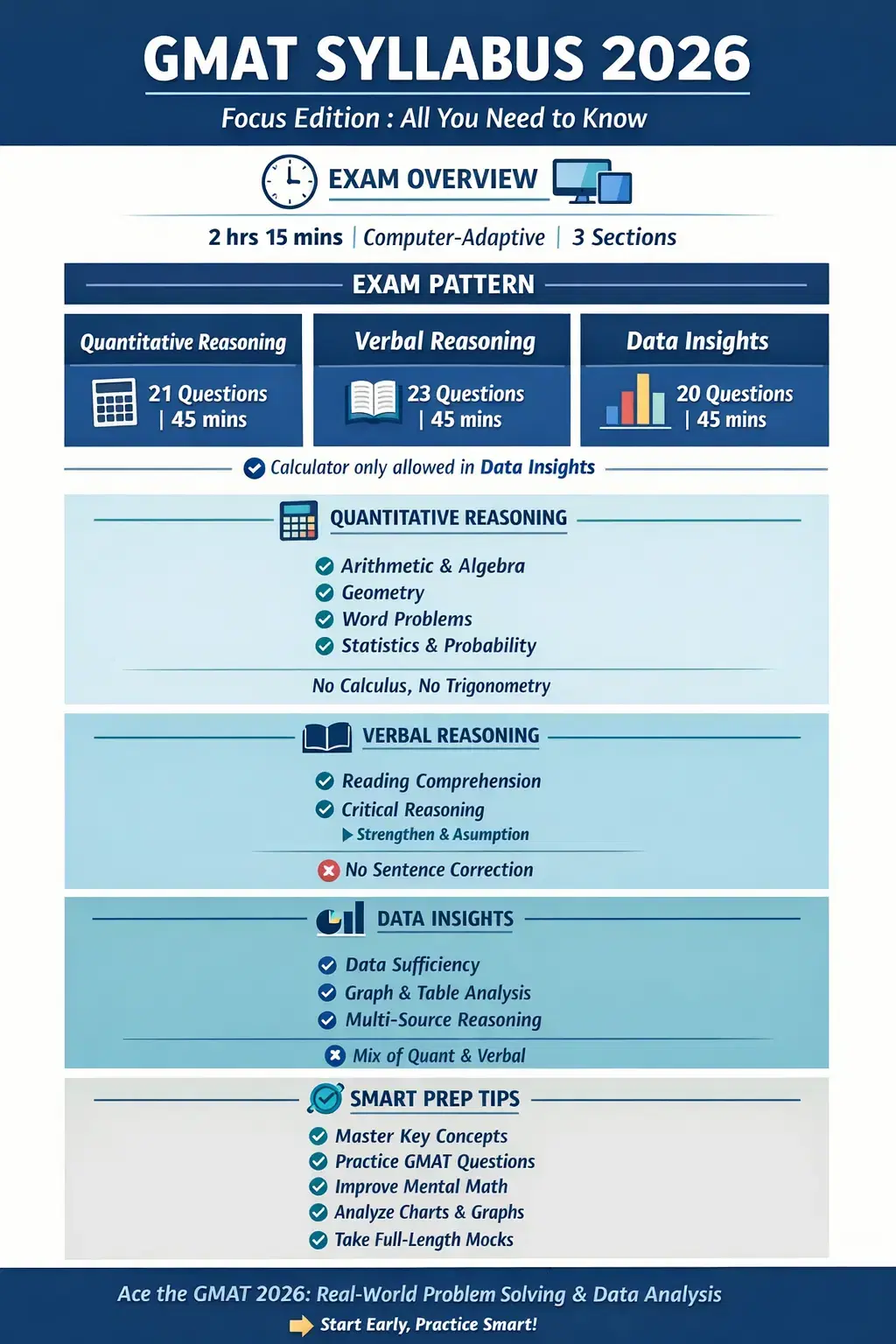
GMAT Syllabus 2026

This article provides a detailed breakdown of the GMAT syllabus, section-wise topics, exam pattern, and preparation tips.

If you’re planning your GMAT attempt in 2026, these related guides will help you complete the registration and scheduling process.

How to register for the GMAT?

What is the GMAT exam fee in India in 2026?

Upcoming GMAT exam dates 2026

GMAT Syllabus 2026

The GMAT syllabus 2026 has been designed to test real-world problem-solving, critical thinking, and data interpretation skills that are essential for business management programs.

Before looking at the syllabus, you must understand the GMAT exam pattern in 2026:

Section

Description

Number of questions

Duration

Quantitative Reasoning

Tests mathematical and problem-solving skills.

21

45 minutes

Verbal Reasoning

Measures reading comprehension and critical reasoning.

23

45 minutes

Data Insights

Evaluates analytical skills, data interpretation, and decision-making.

20

45 minutes

Notes:

  • You can choose section order.

  • All sections are adaptive at question level.

  • Total test time is approximately 2 hours 15 minutes.

Are calculators allowed in the GMAT Focus Edition?

A basic on-screen calculator is provided only for the Data Insights section. For Quantitative Reasoning, calculations must be done manually.


GMAT Quant Syllabus 2026

The Quant section measures your ability to solve mathematical problems and interpret numerical data. It is designed to test logical thinking and analytical application rather than advanced math.

Key Topics:

  • Arithmetic: Integers, fractions, decimals, percentages, ratios, proportions, averages, speed-distance-time, work, profit & loss, simple & compound interest.

  • Algebra: Linear & quadratic equations, inequalities, exponents, absolute values, algebraic expressions, functions.

  • Word Problems: Mixtures, sets, number properties.

  • Geometry: Lines, angles, triangles, circles, polygons, coordinate geometry, perimeter, area, volume.

Notes: Advanced topics like trigonometry, calculus, and higher-level mathematics are not part of the GMAT syllabus.

Preparation Tips:

  • Strengthen basics in arithmetic, algebra, and geometry instead of focusing on higher math.

  • Practice mental calculations and shortcuts to save time.

  • Solve official GMAT practice questions to understand the exam’s logic-based approach.

  • Pay special attention to data sufficiency problems, which often appear tricky.

  • Focus on accuracy first, then improve speed.

How important is mental math in GMAT Quant?

Mental math is very important for the quant section. Quick estimation and mental calculations save time and reduce errors, especially under the 45-minute time limit.


GMAT Verbal Syllabus 2026

The Verbal section evaluates reading comprehension, critical reasoning, and the ability to analyse arguments. It measures how well a candidate can understand and evaluate written material.

Key Topics:

  • Reading Comprehension (RC):

    • Main idea & passage structure

    • Supporting details & examples

    • Inference-based questions

    • Author’s tone, purpose, and perspective

  • Critical Reasoning (CR):

    • Strengthen & weaken arguments

    • Assumption-based questions

    • Evaluate arguments

    • Inference & conclusion-based questions

    • Paradox & flaw detection

  • Logical Structure of Arguments: Understanding the flow of reasoning and evidence.

Note: Sentence Correction (SC) questions, which were part of the old GMAT, have been completely removed in the GMAT Focus Edition.

Preparation Tips:

  • Develop a daily reading habit (editorials, academic journals, business case studies).

  • Focus on identifying argument structures while practising critical reasoning questions.

  • Learn to eliminate wrong answer choices systematically.

  • Practice active reading: highlight keywords, tone shifts, and transitions.

  • Manage time by not over-reading passages, and scan for key points.

Is knowing grammar rules important after Sentence Correction was removed?

Yes, indirectly. Grammar and sentence structure still matter for understanding meaning and logic in verbal passages.


GMAT Data Insights Syllabus 2026

The GMAT Data Insights section is unique to the GMAT Focus Edition. It combines data interpretation, logical reasoning, and decision-making. It is a combination of the earlier Integrated Reasoning and Data Sufficiency sections.

Key Topics:

  • Data Sufficiency: Identify if the given data is enough to answer a problem.

  • Multi-Source Reasoning: Analyze data from multiple sources like text, tables, or charts.

  • Data Comparisons: Evaluate and compare datasets for accuracy and efficiency.

  • Table Analysis: Interpret tabular data, identify trends, and make logical conclusions.

  • Graphical Interpretation: Analyze data presented in bar charts, pie charts, line graphs, and scatter plots.

  • Two-Part Analysis: Solve complex quantitative or verbal problems with two related components.

Note: The Data Insights section requires both quant and verbal reasoning skills since questions combine numbers, text, and logic.

Preparation Tips:

  • Practice Graphic Interpretation, interpreting charts, and data tables quickly.

  • Revise the concepts of probability, percentages, and ratios since they are often embedded in data sets.

  • Learn to identify irrelevant data; don’t waste time analysing everything.

  • Strengthen logical reasoning and quantitative fundamentals, as both are tested together.

  • Time management is crucial; practice skipping lengthy calculations when data trends are obvious.

Should I attempt all Data Sufficiency questions first?

Not necessarily. Start with questions you understand. Strategic skipping can save time without losing accuracy.


How to Prepare for the GMAT Syllabus 2026?

Preparing for the GMAT Focus Edition syllabus requires a balanced approach across all 3 sections: Quantitative Reasoning, Verbal Reasoning, and Data Insights. Since the exam is adaptive and time-bound, you need both conceptual clarity and strategic test-taking skills.

  • Understand the Exam Structure: Familiarise yourself with the updated syllabus and format before starting GMAT preparation.

  • Build Conceptual Clarity: Strengthen basics in arithmetic, algebra, logical reasoning, and comprehension.

  • Practice Data Interpretation: Since Data Insights is a major addition, practice analysing charts, tables, and complex datasets.

  • Time Management: Allocate fixed time per question and practice full-length mock tests to improve pacing.

  • Review & Revise Regularly: Create a revision schedule for formulas, reasoning strategies, and common question types.

  • Use Official GMAT Prep Material: Stick to GMAC’s official GMAT practice sets and question banks for the most accurate preparation.

  • Analyse Mistakes: Review incorrect answers to identify weak areas and focus more on them.

  • Balanced Preparation: Avoid focusing too much on one section; maintain equal practice across Quant, Verbal, and Data Insights.

The GMAT syllabus 2026 is designed to test your real-world problem-solving, critical thinking, and data analysis skills. By understanding the topics in Quant, Verbal, and DI sections and following a smart preparation strategy, you can focus your efforts where they matter most. Stay consistent, practice regularly, and you’ll be ready to tackle the exam with confidence

GMAT scores are reported on a scale of 205-805. The GMAT exam has 3 sections: Verbal Reasoning, Quantitative Reasoning, and Data Insights. Each section is reported on a 60-90 scale. Along with scores, you will also get a percentile that indicates the percentage of test takers you have scored higher than.

Unofficial GMAT scores will be displayed on your screen immediately at the end of the test. The official score report will be available in your mba.com account in 3-5 days. This report includes subscores and performance insights, which remain valid for 5 years from the test date.


GMAT Score Chart 2026

The GMAT total score ranges from 205 to 805, with each section scored in the range from 60 to 90. Here is a breakdown:

Section

Total Score Range

Quantitative Reasoning

60-90

Verbal Reasoning

60-90

Data Insights

60-90

Total Score Range

205-805


How Are GMAT Scores Calculated in 2026?

GMAT scores in 2026 are calculated using a computer-adaptive system.

  • The test is adaptive. If you answer correctly, questions get harder; if wrong, they get easier. This helps quickly find your true ability level.

  • Your section performance matters most. For each section (Quantitative Reasoning, Verbal Reasoning, Data Insights), your score is not just based on how many you got right, but also how difficult those questions were.

  • This turns your "raw" answers into a scaled section score from 60 to 90.

  • Sectional scores are combined with equal weight (one-third each). This gives your final total score from 205 to 805.

  • There's no penalty for incorrect answers, so you are advised to answer every question.

The GMAT score calculator formula is given below:

GMAT Score Calculator Formula 2026

Note: The above formula is not officially published by GMAC. It is derived from the trusted third-party site of Magoosh.


GMAT Score vs Percentile 2026

GMAT percentiles show what percentage of recent test-takers you performed better than. Below is the official table published by the GMAC mapping GMAT raw scores to percentiles:

GMAT Percentile Ranking 2026

Business schools emphasise percentiles because they provide context. A score of 645 (89th percentile) is considered competitive. Aim for 645+ for top B-schools abroad, like Harvard, Stanford, or INSEAD.

Student Insights: Indian students often excel in quant but may need to focus on verbal and data insights for balanced scores.


GMAT Score Report 2026

Unofficial GMAT scores (sectional and total) will be displayed on your computer screen immediately after completing the exam. You are not allowed to record, save, screenshot, or print your unofficial score. You will receive an email when your official score report is available in your mba.com account. If you do not see the email, check your "junk mail" or "spam" folder.

The GMAT Official Score ReportPDF will be available on your mba.com 3-5 business days after the test, from where you can download it. It includes your official score, percentile, and detailed analytics.

Note: The Enhanced Score Report (ESR) option is not available in the Focus Edition. Detailed insights are now integrated with the official score report at no extra cost.

Does my official GMAT score report show whether I took the exam online or at a test center?

Yes, B-schools can see whether your GMAT was taken online or at a test centre, but the exam content and scoring remain the same regardless of format.


How to Send Your GMAT Score to Universities?

GMAT scores can be sent to universities through your mba.com account.

  • The first 5 score reports are FREE, and they must be sent within 48 hours after receiving them.

  • Additional score report fee is USD $35 (approximately INR 3,300).

If I take the GMAT more than once, do schools see all my scores?

With the Focus Edition, you choose which score to send to each school. You do not have to send all past scores.


What is the GMAT Score Validity 2026?

The GMAT scores are valid for a period of 5 years. This gives you flexibility to apply over time, especially useful if you are working or gaining experience after undergraduate degree.


How to Cancel GMAT Scores?

As per GMAC, there is no need to cancel your GMAT scores. You can choose which schools see your GMAT score before taking the exam, so there’s usually no need to cancel your score. If you don’t send it to any school, your scores stay private and are only visible in your mba.com account.

What If GMAC Cancels My Scores?

GMAC reserves the right to cancel your test score when a testing issue occurs, there is a policy violation, or the score is believed to be invalid.

  • You may receive an email stating the time window in which you can appeal for a reinstatement. If you don’t get this email, you will not be able to appeal.

  • You may then appeal against the decision by writing an email to GMAC Test Security at testsecurity@gmac.com. You are advised to take action within 7 days.

  • Based on your appeal, GMAC will provide you with the following options: voluntary score cancellation, a free retest, or appealing the cancellation decision through procedures provided by GMAC.


GMAT Score Requirements for Top B-Schools Abroad 2026

A GMAT score of 700-730 is helpful to get admission to top US, UK, and European B-schools like Wharton, LBS, or HEC Paris. For Indian applicants, a high GMAT score can help if you have limited work experience or want to apply for scholarships.

The scores required for some of the top business schools abroad are given in the table below:

Business School

QS MBA World Ranking 2026

Famous programs among Indian students

GMAT Score Required

Stanford Graduate School of Business

#=4

Entrepreneurship, VC, Tech, General Mgmt (Silicon Valley access)

730-740

The Wharton School

#=1

Finance, PE, VC, Consulting (strong quant, finance focus)

730

Harvard Business School

#=2

General Mgmt, Leadership, Case Method (prestige, network)

730

London Business School

#=6

Finance, Consulting, International (diverse cohort, London hub)

710-720

HEC Paris

#=5

Luxury, Strategy, General Mgmt, International (Europe focus)

690-710

MIT Sloan

#=3

Innovation, Tech, Analytics, Entrepreneurship (quant-heavy)

720-730

Columbia Business School

#=10

Finance, PE, VC, NYC location (Wall Street access)

730

Cambridge Judge

#=7

Strategy, Innovation, Social Impact (UK, Europe network)

700-710

Many schools also accept the GRE as an alternative, but the GMAT is considered a strong indicator of your suitability, as it is an MBA-focused exam.

Note:

  • The B-schools mentioned above are NOT test-optional. However, they do not mention a minimum score, as they do a holistic review of your profile. The scores are the average of the MBA Class of 2027.

  • GMAT score is not the only factor in determining your admissions; essays, recommendations, GPA, and interviews matter too.

GMAT scores provide a standardised measure of performance across Quantitative, Verbal, and Data Insights sections, with scores ranging from 205 to 805 and percentiles showing how you compare globally. Scores remain valid for five years, and you control which schools see your official report. Strong GMAT scores can strengthen your MBA application, but admissions decisions also consider work experience, academics, essays, and interviews.