


Registration
Required Documents
To register for the GRE, candidates must meet specific criteria set by ETS, including providing a valid government-issued ID, such as a passport. ETS also offers special accommodations for candidates with disabilities to ensure equal access, including options like Braille and additional test preparation materials.
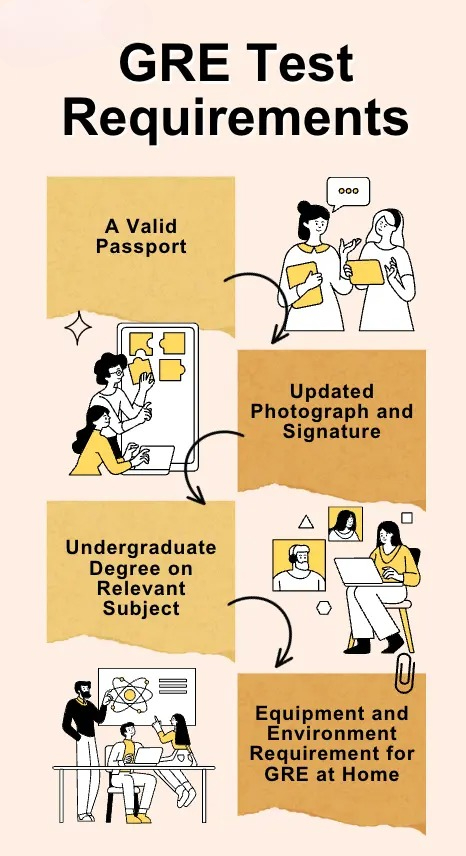
This article outlines the detailed GRE registration requirements, ID guidelines, and the process for requesting accommodations, ensuring that all candidates are well-informed and prepared for the test.
What Should We Carry to the GRE Test Center?
To register for the GRE, the document requirements are minimal. The only essential requirement is a valid ID issued by the government. The only accepted ID in India is a passport, which should not be expired and must have a recent, clear photo of the candidate.
Here are the key points to remember:
The name on the passport must match the name on the GRE application.
The signature on the passport should match the one on the exam form.
The passport photo must be clear and easily recognizable.
Photocopies of the ID are not accepted; only the original ID is allowed. ETS is very strict about this rule. If the name on the application form doesn’t match the name on the ID, the candidate’s application will be canceled.
On the test day, your ID will be carefully checked and verified. In addition to the ID check, you may also need to go through some biometric checks, including:
A voice recording.
Fingerprint or thumb impression matching.
Possibly a videotaping process.
Signature verification.
These steps are to ensure the security and accuracy of your identification before you are allowed to take the GRE.
Also Read: GRE Eligibility
GRE General ID Requirements
There are a few exceptions to the ID documents that must meet all of the following requirements. GRE general ID document requirements must follow the criteria below:
Must bring an original document; photocopied documents are not acceptable, and documents cannot be presented on a cell phone or any other electronic device
The document must be a government-issued national/state/province identity card that is recognized by the country in which you are a citizen or permanent resident
Also, the document must be valid. It must not have expired
The document must have your first and last name exactly (excluding accents) as it was when registering for the test
The photograph in the document must be a recognizable one.
It must include your signature
Documents Not Accepted for GRE
A candidate must hold other ID proof, which may be accepted for all other purposes, but for GRE, these will not be accepted. The following ones can be named for this purpose:
Photocopy of ID proof
Expired ID proof
Soft copies of the ID proof
International student ID card
Employee ID card
International driving license
Draft classification card
Credit/debit card
Birth certificate of the candidate
Notary-prepared letter or document
Social security card
Temporary ID proofs
Diplomatic ID card
Consulate ID card
Embassy ID card
Any document that is not recognized by a government agency
What if a Candidate Cannot Meet the ID Requirement for GRE?
Although ETS is strict about ID requirements for GRE registration, there are exceptions for certain candidates. For example, individuals granted political asylum or those with refugee status may not have access to a valid passport. ETS understands this situation and allows these candidates to submit alternative documents.
To do so, candidates must contact the Office of Testing Integrity (OTI) for approval. This approval must be obtained at least 7 days before the GRE registration. If the OTI approves the alternative document, the candidate will still be able to take the exam, but they will not be eligible for a refund if they are unable to attend or if the document is later deemed invalid.
The OTI will carefully review the alternative document before approving. Below is the contact information for ETS's Office of Testing Integrity for any further inquiries or document submissions.
TSReturns@ets.org | |
Phone | 1-609-406-5430 (all other locations) Monday–Friday 7:30 a.m.–5:30 p.m. ET |
Fax | 1-609-406-9709 |
Other Requirements of GRE
ETS, the authority conducting the GRE, does not have specific age or educational requirements for booking a test center. However, since the GRE is designed for graduate-level courses, it is expected that candidates have completed their undergraduate studies and obtained their degree before applying.
The GRE is open to candidates who wish to pursue graduate programs in fields such as business, engineering, law, and more.
GRE Testing Accommodations for Candidates with Disabilities
ETS understands the importance of addressing candidates' health and accessibility needs. To support individuals with disabilities, they offer several facilities for the GRE. Some of the key provisions include:
Braille: For the GRE General Test, candidates with visual impairments can use JAWS (Job Access With Speech) software, with or without Braille. To avail this, candidates need to fill out a form during the registration process.
Check the GRE Testing Accommodation Form here.
Test Preparation Materials: ETS provides preparation materials specifically designed to help candidates with disabilities. These resources are aimed at boosting confidence and improving performance on test day. Candidates can access these materials through the GRE preparation page.
Accommodations: ETS offers accommodations to candidates with health issues or disabilities. Candidates can request accommodations by submitting a form. Approval is subject to ETS Disability Services. It is recommended to apply for accommodations at least 6 weeks before the GRE test date, as paperwork and processing can take time.
By providing these services, ETS ensures that candidates with disabilities have equal access to the test and are well-supported throughout the process.
The GRE has straightforward requirements for registration, primarily focusing on a valid ID proof. ETS ensures accessibility for all candidates, offering accommodations for those with disabilities. By following the outlined procedures and planning ahead, candidates can easily meet the necessary criteria for a smooth GRE experience. Whether you're applying for graduate programs or seeking special accommodations, understanding these requirements will help ensure you're fully prepared for the exam.