Syllabus
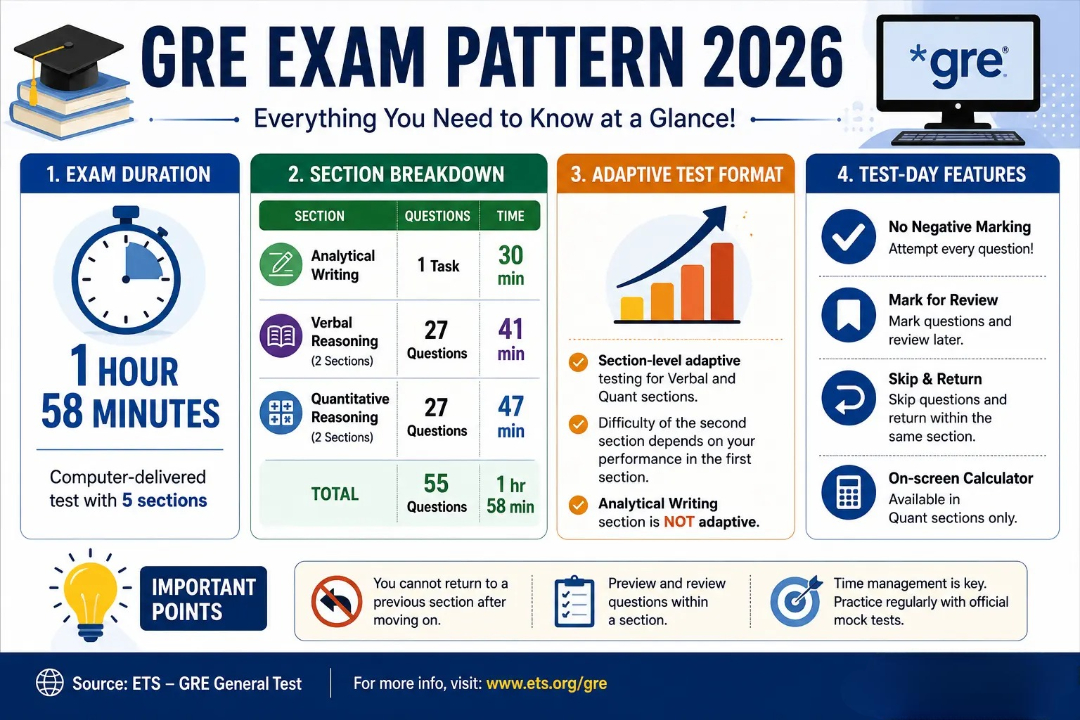
Full pageThe GRE exam syllabus 2026 is designed to test key skills for graduate school, under 3 sections: Verbal Reasoning, Quantitative Reasoning, and Analytical Writing. The General Test includes 2 Verbal sections (reading comprehension, sentence completion), 2 Quantitative sections (math topics like algebra and geometry), and 1 Analytical Writing task. The test lasts about 1 hour and 58 minutes.
In addition to the GRE General Test, there are subject-specific exams like Math, Physics, and Psychology. These cover specialised topics such as algebra and calculus for Math, mechanics and electromagnetism for Physics, and cognitive and clinical psychology for Psychology.
GRE General Test Syllabus 2026
The GRE syllabus evaluates verbal, reasoning, critical thinking, and analytical writing skills of candidates. Before looking at the syllabus, you must understand the GRE General Test pattern, as given in the table below.
Sections | Number of Questions | Allocated Time |
|---|---|---|
Verbal Reasoning | Section 1: 12 questions Section 2: 15 questions | Section 1: 18 minutes Section 2: 23 minutes |
Quantitative Reasoning | Section 1: 12 questions Section 2: 15 questions | Section 1: 21 minutes Section 2: 26 minutes |
Analytical Writing | 1 "Analyze an Issue" task | 30 minutes |
GRE Verbal Reasoning Syllabus 2026
The verbal section tests your ability to parse complex ideas, identify key points, and understand textual structures and vocabulary. Some questions require you to read passages and answer questions on those passages, while the rest evaluate your skills in reading, interpreting, and completing existing sentences, groups of sentences, or paragraphs.
The GRE verbal syllabus topics are listed below:
Nouns, Pronouns, Adjectives
Verb Tense
Idioms & Idiomatic Expressions
Pronoun Agreement
Subject-Verb Agreement
Modifiers
Parallelism
GRE Quantitative Syllabus 2026
The Quant section assesses your basic mathematical skills. The questions are posed in real-life settings, while some are completely based on mathematical settings. Solving Quant questions requires fundamental principles and abilities in arithmetic, geometry, data analysis, and knowledge of GRE algebra.
The table below gives the various topics under the GRE Quant syllabus.
Arithmetic | Algebra | Geometry | Data Analysis |
|---|---|---|---|
|
|
|
|
GRE Subject Test Syllabus 2026
The GRE Subject Test syllabus covers key concepts, theories, principles, and problem-solving skills within the chosen subject. The available subjects are: Maths, Physics, and Psychology, and the questions are all of multiple-choice type.
GRE Math Syllabus 2026
The GRE Maths syllabus comprises topics derived from courses frequently available at the undergraduate level. The duration is 2 hours and 50 minutes to complete the questions on the GRE mathematics syllabus.
Subject (Weightage) | Topics |
|---|---|
Algebra (25%) | Elementary Algebra, Linear Algebra, Abstract Algebra, and Number Theory. |
Calculus (50%) | Differential Calculus, Integral Calculus, Calculus Application and Connection with Coordinate Geometry, Trigonometry, Differential Equations, and others. |
Additional Topics (25%) | Differentiability and Integrality, Elementary Topology of R, Rn, Discrete Math, Geometry, Graph, Statics, and more. |
GRE Physics Syllabus 2026
The GRE Physics Subject test consists of questions based on diagrams, graphs, experimental data, and descriptions of physical situations. The topics on GRE physics exam covered are:
Classical Mechanics (20%)
Electromagnetism (18%)
Optics and Wave Phenomena (9%)
Thermodynamics and Statistical Mechanics (10%)
Quantum Mechanics (12%)
Atomic Physics (10%)
Special Relativity (6%)
Laboratory Methods (6%)
Specialized Topics (9%)
The numbers within the parantheses indicate the weightage of each topic in the paper, as indicated by ETS.
GRE Psychology Syllabus 2026
The GRE Psychology subject test consists of the following topics:
Biological (30 questions)
Cognitive (29 questions)
Social (19 questions)
Developmental (18 questions)
Clinical (23 questions)
Measurement and Methodology (25 questions)
Top GRE Syllabus Preparation Tips
You can prepare for the GRE through coaching centers, practice papers, or self-study. The ETS website offers various preparation courses, or you can join coaching programs with high success rates. Here are some simple tips to help you prepare for the GRE:
Get familiar with the GRE exam pattern.
Review the GRE syllabus and understand what topics will be tested.
Create a study plan and set aside time for each section.
Consider taking a GRE prep course or getting a tutor if needed.
Use reliable study materials like official practice tests and prep books.
Practice sample questions to get used to the types of questions and improve time management.
Focus on improving your verbal reasoning, math, and writing skills.
Develop strategies for answering different types of questions.
Spend extra time on areas where you struggle the most.
Practice time management to make sure you can finish the test on time.
Stay organized and track your progress to see where you need more practice.
Read More:GRE Preparation Tips
The GRE syllabus 2026 covers essential skills needed for graduate study through the General and Subject Tests. Understanding the exam structure and topic-wise syllabus helps candidates prepare efficiently and focus on areas that matter most for their target programs and universities.
Key Summary
The GRE tests Verbal Reasoning, Quantitative Reasoning, and Analytical Writing skills.
The general exam includes 2 Verbal sections, 2 Quantitative sections, and 1 Analytical Writing task, lasting about 1 hour and 58 minutes.
GRE Subject Tests cover specialized topics like Math, Physics, and Psychology.
Verbal Reasoning tests reading comprehension, sentence completion, and vocabulary.
Quantitative Reasoning focuses on arithmetic, algebra, geometry, and data analysis.
Subject Tests in Math, Physics, and Psychology cover topics specific to each field.
The GRE syllabus requires strong skills in reasoning, critical thinking, and problem-solving.
Preparation tips include familiarizing yourself with the exam format, creating a study plan, and practicing sample questions.
Recommended books and practice papers can help structure your study and improve time management.
Top scores are needed for admission to top universities, with 320+ being a good target for MS programs.