

Marks vs Rank vs Percentile
Full pageThe JEE Main 2026 Session 2 has been conducted successfully from April 2 to April 8, with more than 11 lakh candidates appearing for the exam.
As the Exam was held in multiple shifts, with the same marks, you can have a different percentile according to the difficulty of the paper & overall performance of the candidates.
The April session was overall easier than the January session, with most of the shifts being easy to moderate in difficulty level.
The 99th percentile in the JEE Main 2026 is expected to be secured with around 150-190 marks.
With a score of around 80-130, a candidate can secure the 94th percentile in the JEE Main 2026.
In JEE Main session 1, the cutoff marks for the 99.9th percentile in the toughest shift were around 219, and for the easiest shift were around 234. A candidate can secure a 96th percentile with around 110-122 marks according to their shift difficulty.
You can watch the following video by MathonGo for a detailed JEE Main Marks vs Percentile analysis for the January session.
Related Articles:
JEE Main 2026 Session 2 Result Date Out: Download Scorecard (Soon)
JEE Main 2026 Session 2 Category-wise Cutoff
JEE Main 2026 Session 2 Answer Key on April 11

Key Summary
In the January session, the JEE Main exam difficulty was on the tough side, which is likely to influence the overall Marks vs Percentile Analysis.
In JEE Main 2026, around 80-130 marks will be required to qualify for the JEE Advanced, which is likely to get you in the 94th percentile.
In 2025, to get a rank under 200, a candidate had to secure a 99.99th Percentile.
Various factors, such as seat availability, performance of the candidates, and difficulty level of the paper, will influence the Mark vs Rank vs Percentile analysis.
In the January session of JEE Main 2026, the lowest marks for the 99th percentile were around 155 in the 22 January shift 2.
What are JEE Main Marks vs Percentile?
The JEE Main Marks vs Percentile will show how your raw scores will be converted into a percentile score, showing your performance as compared to other candidates in your shift.
The JEE Main Percentile will be calculated separately for each session, not for the entire exam.
JEE Main Marks vs Percentile vs Rank (Expected)
The AIR will be prepared by the normalised percentile, not your raw marks.
By scoring 190-210 marks, the candidates can reach upto 99 percentile.
In the range of 120 to 160 marks, a difference of 5 to 10 marks can cause a large percentile shift.
Raw Marks (out of 300) | Expected Percentile | Approx AIR Range | Competition Band |
|---|---|---|---|
260+ | 99.8 – 100 | Top 1,000 | Top 0.1% |
240 – 259 | 99.6 – 99.8 | 1,000 – 3,500 | Elite NIT/IIT zone |
220 – 239 | 99.3 – 99.6 | 3,500 – 7,000 | Top NIT CSE |
200 – 219 | 99 – 99.3 | 7,000 – 12,000 | NIT CSE/ECE |
170 – 199 | 97.5 – 99 | 12,000 – 25,000 | Core NIT branches |
140 – 169 | 96 – 97.5 | 25,000 – 45,000 | Mid NIT/IIIT |
120 – 139 | 94 – 96 | 45,000 – 70,000 | JEE Adv cutoff zone |
100 – 119 | 90 – 94 | 70,000 – 1,00,000 | Qualifying range |
Below 100 | Below 90 | 1,00,000+ | Low percentile band |
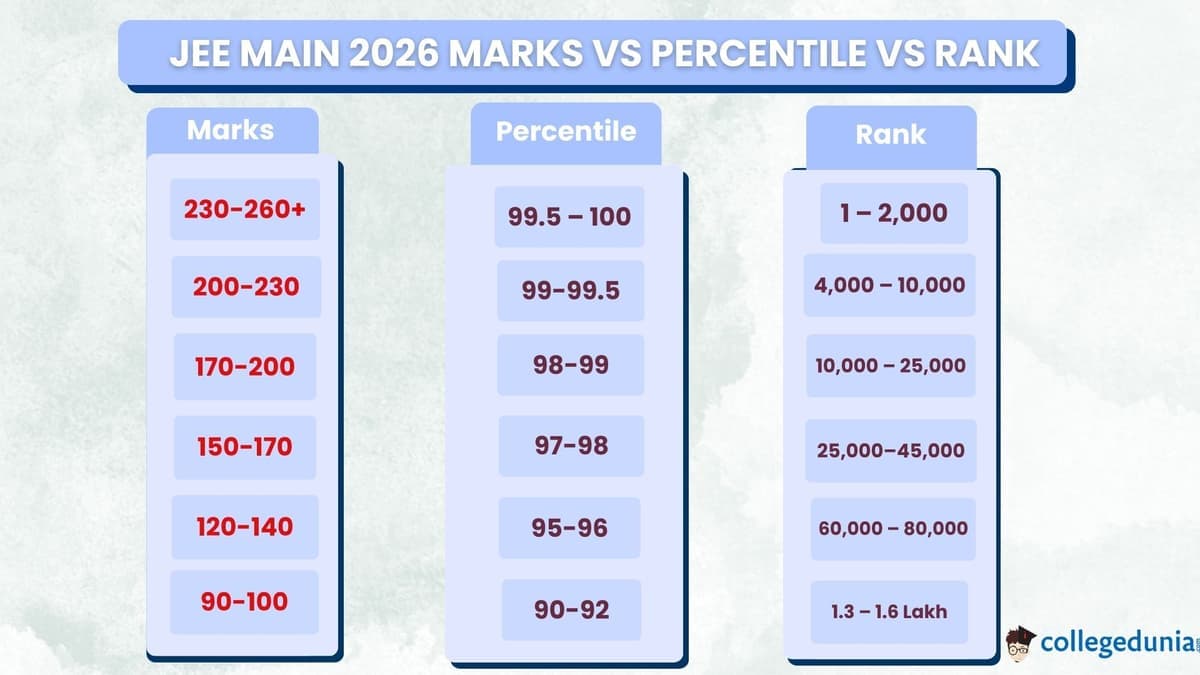
As per the previous year, with a difference of 5 to 10 marks, around 99 percentile, your rank can be shifted by thousands, making the percentile more important than raw marks.
Also Check:
Safe Score for JEE Main 2026 for the General Category |
Safe Score for JEE Main 2026 for the OBC Category |
Safe Score for JEE Main 2026 for the SC Category |
Safe Score for JEE Main 2026 for the ST Category |
Ques. How many marks are typically needed for a rank under 20,000?
Ques. What marks are needed for the top 100 ranks in recent JEE Main sessions?
JEE Main Marks vs Percentile 2026 Shift-wise
The JEE Main Marks vs percentile will be different for each shift as per the difficulty level.
So, the normalisation method will be applied for each shift, the raw marks will be different for each percentile as per the difficulty, with tougher shifts having higher percentiles.
JEE Main April 2026 Marks vs Percentile Shift-Wise (Expected)
In the JEE Main April session, the toughest shift was the April 6 shift 1, as per students' feedback and detailed paper analysis by experts. The easiest shift was the April 2 shift 2, in which the expected marks required to secure a 99th percentile are 192.
Candidates are expected to secure the 98th Percentile is the JEE Main April session with around 152-170 marks.
The 97th percentile is expected to be secured by candidates with marks ranging from 138 to 157.
Marks ranging from 119 to 135 are expected to secure a 95th percentile in the JEE Main 2026 April session.
In the JEE Main 2025 session 2, the average score was around 183 as compared to 199 in 2024 and 182 in 2023.
Percentile | Apr 2 M (S1) | Apr 2 E (S2) | Apr 4 M (S1) | Apr 4 E (S2) | Apr 5 M (S1) | Apr 5 E (S2) | Apr 6 M (S1) | Apr 6 E (S2) | Apr 8 E (S2) |
|---|---|---|---|---|---|---|---|---|---|
99 | 175 | 192 | 176 | 182 | 178 | 188 | 174 | 185 | 189 |
98.5 | 161 | 178 | 162 | 170 | 164 | 174 | 160 | 171 | 174 |
98 | 152 | 170 | 153 | 162 | 155 | 166 | 151 | 163 | 164 |
97.5 | 144 | 162 | 145 | 154 | 147 | 158 | 143 | 155 | 158 |
97 | 139 | 157 | 140 | 148 | 142 | 153 | 138 | 150 | 152 |
96.5 | 132 | 150 | 133 | 142 | 135 | 146 | 131 | 144 | 147 |
96 | 128 | 145 | 129 | 137 | 131 | 141 | 127 | 139 | 140 |
95.5 | 125 | 140 | 126 | 132 | 128 | 136 | 124 | 134 | 135 |
95 | 119 | 135 | 120 | 128 | 122 | 131 | 118 | 129 | 133 |
94 | 113 | 128 | 114 | 121 | 116 | 124 | 112 | 122 | 125 |
93 | 107 | 120 | 108 | 115 | 110 | 117 | 106 | 115 | 118 |
92 | 102 | 113 | 103 | 109 | 105 | 110 | 101 | 108 | 113 |
Also check:
JEE Main 2026 Marks vs Percentile vs Rank (Expected)
JEE Main 2025 Marks Vs Percentile April Shift
JEE Main Marks Vs Percentile Vs Rank Predictor 2026
JEE Main 2026 Session 1 Shift-Wise Marks vs Percentile Analysis
The JEE Main session 1 Marks vs Percentile for the 99th percentile was around 177 for the easiest shift and around 155 for the toughest shift.
The 97th percentile was secured with marks ranging from 120 to 132 based on the difficulty of the shift.
Students with marks ranging from 131 to 147 secured the 98th percentile in the JEE Main session 1.
Date & Shift (2026) | 99 %ile | 98.5 %ile | 98 %ile | 97.5%ile | 97 %ile |
|---|---|---|---|---|---|
JEE Main Marks vs Percentile 21 Jan Shift 1 | 167 | 154 | 144 | 137 | 130 |
JEE Main Marks vs Percentile 21 Jan Shift 2 | 171 | 157 | 147 | 139 | 132 |
JEE Main Marks vs Percentile 22 Jan Shift 1 | 158 | 144 | 134 | 126 | 120 |
JEE Main Marks vs Percentile 22 Jan Shift 2 | 155 | 143 | 131 | 126 | 120 |
JEE Main Marks vs Percentile 23 Jan Shift 1 | 158 | 145 | 135 | 127 | 121 |
JEE Main Marks vs Percentile 23 Jan Shift 2 | 163 | 150 | 139 | 132 | 126 |
JEE Main Marks vs Percentile 24 Jan Shift 1 | 162 | 150 | 141 | 134 | 127 |
JEE Main Marks vs Percentile 24 Jan Shift 2 | 160 | 146 | 137 | 128 | 121 |
JEE Main Marks vs Percentile 28 Jan Shift 1 | 161 | 149 | 138 | 132 | 126 |
JEE Main Marks vs Percentile 28 Jan Shift 2 | 162 | 150 | 140 | 133 | 126 |
Source: JEE Main 2026: Safe Score for 9X Percentile | MathonGo | Anup Sir
According to Reddit, the 23rd January Shift 2 was the toughest shift, so the marks will be lower, and the 22nd January Shift 1 was the easiest, so the marks will be comparatively higher.
Related Articles:
JEE Main Shift-Wise Marks vs Percentile 2025
JEE Main Shift-Wise Marks vs Percentile 2024
Ques. How do marks vs rank trends differ between easy and difficult shifts?
Ques. What is the rank drop per 10-mark increase around 200 marks?
Ques. Which shift is usually tougher in JEE Main – Shift 1 or Shift 2?
JEE Main 2026 Subject-Wise Marks vs Percentile Analysis
In JEE Main, the percentile is calculated based on total score, but subject-wise marks performance will affect your final ranking.
As per the recent trends, mathematics acts as a major rank differentiator, whereas Physics & chemistry requires accuracy and score stability.
Below is a subject-wise estimate of how marks translate into strong percentile ranges.
JEE Main Marks vs Percentile for Mathematics
Maths Marks (out of 100) | Expected Overall Percentile Impact | Approx Total Score Needed | Trend Insight |
|---|---|---|---|
80 – 100 | 99.5 – 100 | 240+ total | Top rank booster |
65 – 79 | 99 – 99.5 | 210 – 240 | Strong 99th percentile support |
50 – 64 | 97 – 99 | 180 – 210 | Competitive zone |
35 – 49 | 95 – 97 | 150 – 180 | Average scoring band |
Below 35 | Below 95 | <150 | Limits the top percentile |
JEE Main Marks vs Percentile for Physics
Physics Marks (out of 100) | Expected Overall Percentile Impact | Approx Total Score Needed | Trend Insight |
|---|---|---|---|
85 – 100 | 99.5+ support | 230+ total | Accuracy-driven boost |
70 – 84 | 99th percentile support | 200 – 230 | Strong performance |
55 – 69 | 97 – 99 | 170 – 200 | Stable scoring band |
40 – 54 | 94 – 97 | 140 – 170 | Average zone |
Below 40 | Below 94 | <140 | Low impact |
JEE Main Marks vs Percentile for Chemistry
Chemistry Marks (out of 100) | Expected Overall Percentile Impact | Approx Total Score Needed | Trend Insight |
|---|---|---|---|
85 – 100 | Strong 99.5+ support | 220+ total | High-scoring subject |
70 – 84 | 99th percentile support | 190 – 220 | Score stabilizer |
55 – 69 | 97 – 99 | 160 – 190 | Consistent scoring |
40 – 54 | 94 – 97 | 130 – 160 | Average band |
Below 40 | Below 94 | <130 | Low percentile push |
Check:
JEE Main Expected Category-Wise Cutoff
JEE Main Percentile vs Rank Predictor
What is the Difference Between Raw Marks and Percentile Score?
In JEE Main, your raw marks are the score obtained out of 300, but your percentile will show your percentage as compared to lakhs of candidates.
As more than 13 - 14 lakh students appear and the exam is held in multiple shifts, NTA will use the normalisation method to convert into percentiles before preparing the ranks.
JEE Main Raw Marks vs Percentile
Parameter | Raw Marks (Score) | Percentile Score |
|---|---|---|
What it shows | Total marks out of 300 | % of candidates you outperformed |
Used for AIR | Not used directly | Used for final rank |
Shift impact | Same marks across shifts | Changes with shift difficulty |
Top 1% range | 230–250+ marks | 99.5–100 percentile |
95 percentile range | 130–150 marks | 95 percentile |
JEE Adv cutoff zone | 90–110 marks | 93–95 percentile |
Variation factor | Fixed score | Depends on normalisation & competition |
Session rule | Highest marks not considered | Best percentile across sessions used |
JEE Main Raw marks vs Percentile range
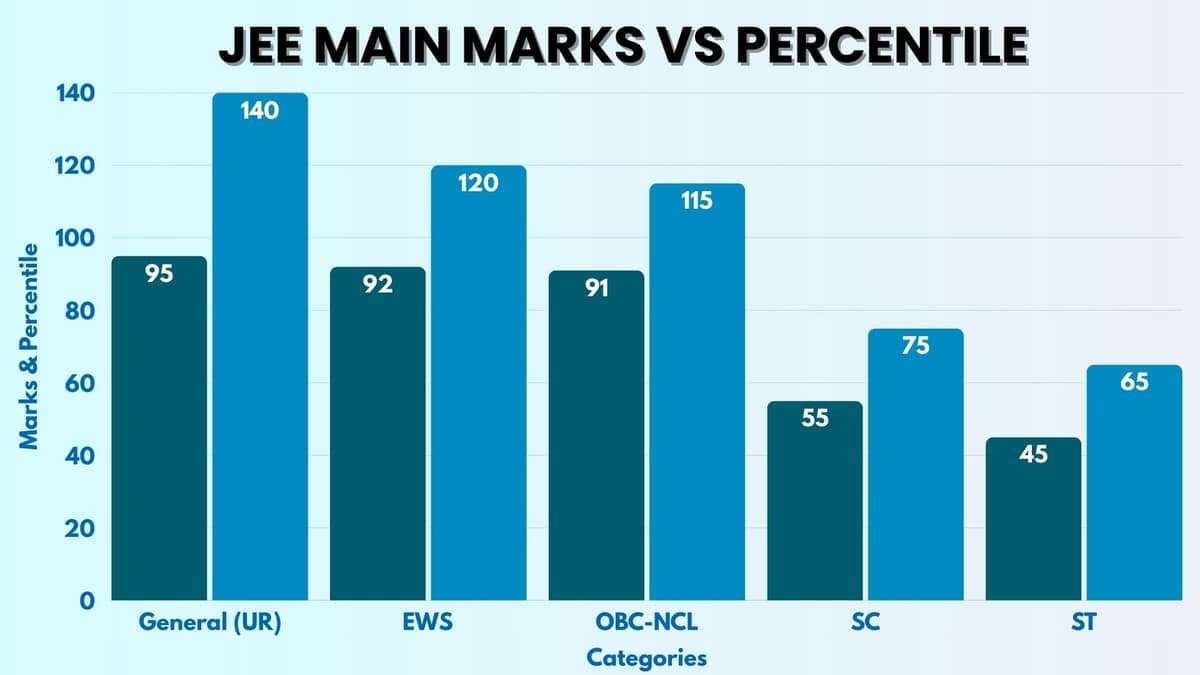
The General Category Candidate requires 120-140 marks (around the 93.5–95th percentile) to qualify for JEE Advanced.
For OBC/EWS Candidates, the qualifying percentile can be 20 to 30 marks lower than the general category.
With the same percentile, reserved category candidates will require better JoSAA Seat options because of category-wise ranks.
Category | Qualifying Percentile (Expected) | Safe Marks Range | Approx AIR Range |
|---|---|---|---|
General (UR) | 93.5 – 95.0 | 120 – 140 | Up to 1,10,000 |
EWS | 90.0 – 92.0 | 100 – 120 | Up to 1,50,000 |
OBC-NCL | 89.0 – 91.0 | 95 – 115 | Up to 1,60,000 |
SC | 50.0 – 55.0 | 55 – 75 | Up to 4,50,000 |
ST | 40.0 – 45.0 | 45 – 65 | Up to 6,00,000 |
Check:
List of Colleges for 50,000 to 75,000 rank in JEE Main
JEE Main colleges for ranks below 50,000
List of Colleges accepting 90+ Percentile in JEE Main 2026
JEE Main College-List Rank Wise
Ques. How do category ranks (OBC/SC/ST) differ from CRL for the same marks?
Ques. What is the expected rank for 280+ marks in the latest JEE Main data?
Factors Affecting JEE Mains Marks vs Percentile 2026
In JEE Main 2026, raw marks do not directly decide your rank, as the percentile is a relative score. The Marks vs Percentile will be influenced by various factors given below, such as:
Shift-wise Difficulty Level: In tougher shifts, fewer marks are needed for the same percentile, whereas in easier shifts, more marks will be required for the same percentile.
Normalisation Level: NTA calculates the percentile separately for each shift, then normalises scores so that a candidate in a difficult shift is not advantaged.
Number of candidates appearing: If the number of candidates appearing is more than, it can tighten the percentile distribution.
Performance distribution in the shift: If many candidates score high in the exam, then the marks required for the top percentile will also rise.
Subject-wise performance & accuracy: Strong performance in all subjects will boost the overall score as well as increase the marks required for a particular percentile.
Best of two sessions policy: Your final percentile or rank will be based on the better performance between session 1 and session 2. A good session 2 attempt can improve your rank even if session 1 was average.
JEE Main 2026 Percentile Vs Rank
In JEE Main, your All India Rank is prepared based on the percentile after normalisation. Candidates with the same marks may receive slightly different marks depending on the difficulty of the shift.
Percentile | Expected Rank |
|---|---|
99.99+ | Top 100 |
99.9+ | Under 1,000 |
99.5+ | 1,000-5,000 |
99.0+ | 5,000-10,000 |
98.5+ | 10,000-15,000 |
98.0+ | 15,000-22,000 |
97.0+ | 22,000-35,000 |
96.0+ | 35,000-45,000 |
95.0+ | 45,000-55,000 |
94.0+ | 55,000-65,000 |
93.0+ | 65,000-75,000 |
92.0+ | 75,000-85,000 |
91.0+ | 85,000-95,000 |
90.0+ | 95,000-1,10,000 |
JEE Main 2026 Marks vs Rank
The JEE Main uses percentile scores and not raw marks for the All India Rank due to normalisation across multiple shifts and sessions.
The relationship between marks, percentile, and rank varies slightly every year depending on exam difficulty, number of candidates, and candidates' performance.
Marks (out of 300) | Expected AIR (Rank) Range |
|---|---|
271 – 300 | 1 – 100 |
241 – 270 | 100 – 1,000 |
221 – 240 | 1,000 – 4,000 |
201 – 220 | 4,000 – 8,000 |
181 – 200 | 8,000 – 15,000 |
161 – 180 | 15,000 – 25,000 |
141 – 160 | 25,000 – 45,000 |
121 – 140 | 45,000 – 80,000 |
101 – 120 | 80,000 – 1,40,000 |
81 – 100 | 1,40,000 – 2,20,000 |
61 – 80 | 2,20,000 – 3,50,000 |
40 – 60 | 3,50,000 – 5,00,000+ |
What is a good score in JEE Main session 2 2026?
A good score in the JEE Main is relative as it depends on the student’s goal, whether you are focusing on JEE Advanced qualification or admission in NIT or IIIT.
After the JEE Main session 2, the best percentile across both sessions will be considered for the final rank.
Given below is the good score for the JEE Main session 2 based on experts' analysis:
Score Range (Marks) | Expected Percentile | Approx. AIR (Rank) | What It Means / Admission Prospects (General Category) |
|---|---|---|---|
250+ | 99.9+ | Top 1–2,000 | Excellent – Top IITs via Advanced, premium NIT CSE |
220–249 | 99.7 – 99.89 | 2,000 – 5,000 | Very Good – Good NITs/IIITs (CSE/ECE possible) |
200–219 | 99.0 – 99.69 | 5,000 – 12,000 | Good – Core branches in top NITs, strong IIITs |
180–199 | 98.0 – 98.99 | 12,000 – 25,000 | Decent – Mid-tier NITs, many IIITs/GFTIs |
160–179 | 96.5 – 97.99 | 25,000 – 45,000 | Average – Newer NITs, lower branches |
140–159 | 94.0 – 96.49 | 45,000 – 70,000 | Safe for lower NITs/GFTIs |
120–139 | 90.0 – 93.99 | 70,000 – 1,20,000 | Basic qualification, private/state colleges |
100–119 | ~85 – 90 | 1,20,000+ | Minimum for many private options |
Also Read:
JEE Main 2026 Marks vs Percentile vs Rank (Expected)
JEE Main 2025 Marks Vs Percentile April Shift
JEE Main Marks Vs Percentile Vs Rank Predictor 2026
99 Percentile in JEE Main 2026: How Many Marks Do You Need in Easy vs Tough Shifts?
The Score of 99 percentile in JEE Main is a benchmark for admission in top NITs and IIITs, but the required marks are not fixed.
The difficulty level of the exam will vary as per different shifts, from moderate to tough. Normalisation will ensure that candidates in harder shifts can achieve the same percentile with fewer marks.
Expected Marks for 99 Percentile (Shift-wise)
Shift Difficulty | Expected Marks for 99 Percentile | Attempt Accuracy Needed | Competition Level |
|---|---|---|---|
Easy Shift | 185 – 200 | 85–90% accuracy | Very high |
Moderate Shift | 160 – 175 | 80–85% accuracy | High |
Tough Shift | 140 – 155 | 75–80% accuracy | Moderate–high |
Very Tough (rare) | 130 – 145 | 70–75% accuracy | Balanced by normalisation |
JEE Main Marks vs Percentile Predictor
The JEE Main Marks vs Percentile Predictor will help you have an estimation of your expected percentile range, as per the raw marks, according to previous year trends, normalisation, and different shift difficulty.
20 Marks in JEE Main Percentile
The Percentile of candidates scoring 20 marks will be below 50, as most of the candidates score above this range.
The AIR for 20 Marks will be more than 5 to 8 lakhs, which shows very low relative performance.
This score range is not sufficient for qualifying for the JEE Main exam for any category.
70 Marks in JEE Main Percentile
The Percentile for this range is expected to be 70 to 78, depending upon the difficulty level of each shift.
The AIR for this category will be around 3 to 4 lakh, which is not enough for admission into central institutes.
The Admission chances can be possible in state engineering colleges by the JEE Main Scores.
80 Marks in JEE Main Percentile
The Percentile will be in the range of 80 to 85, which is below the general category qualifying cutoff.
The Expected AIR will be 2 to 2.5 lakh candidates, which is not enough for the general category.
The Reserved category candidates can clear this qualifying cutoff and can be eligible for counselling.
100 Marks in JEE Main Percentile
For 100 marks, the percentile will be in the range of 88 to 92 percentiles; the tougher shift exams can have a higher percentile.
The AIR will be in the range of 1.2 to 1.6 lakhs, which makes the lower GFTIs and some NITs for Reserved Candidates possible.
For the general category candidates, this score will not guarantee any JoSAA Seats, but the options will be open by CSAB Rounds.
120 Marks in JEE Main Percentile
For 120 Marks, the percentile will be in the range of 94 to 97 percentiles, with a rank range of 30,000 to 80,000.
In this range, the branches available can be Civil, Mechanical, & chemical engineering as per the category and home state.
The Candidates scoring in this range score better in physics and chemistry, whereas the rank becomes different because of maths.
150 Marks in JEE Main Percentile
With 150 marks, the percentile will be around 97 to 99%ile, with the rank range of 15,000 to 25,000.
By scoring in this range, admission can be possible in top and mid-tier NITs, in different branches like ECE, EEE & ME.
In this range, the difference in small marks can also cause a major change in the ranks.
Check:
200 Marks In JEE Main Percentile | 120 marks in JEE Main percentile |
250 marks in JEE Main percentile | 150 Marks in JEE Main Percentile |
180 Marks in JEE Main Percentile | 220 Marks in JEE Main Percentile |
50 Marks in JEE Main Percentile | 190 Marks in JEE Main Percentile |
70 Marks in JEE Main Percentile | 40 Marks in JEE Main Percentile |
30 Marks in JEE Main Percentile | 10 Marks in JEE Main Percentile |
JEE Main Marks vs Percentile Previous Years Trend (2023-2025)
In the JEE Main, the 99.99th percentile was secured with around 280+ marks in the past 3 years. Around 200 marks had secured candidates in the 99th percentile.
The JEE Main cutoff marks for the 98th percentile were in the range of 180-199 marks in the last 3 years.
Around 140-159 marks in the JEE Main 2025 had secured around the 95th- 97th percentile.
Marks (out of 300) | 2025 Approx. Percentile | 2024 Approx. Percentile | 2023 Approx. Percentile |
|---|---|---|---|
280 – 300 | 99.99+ | 99.99+ | 99.99+ |
260 – 279 | 99.94 – 99.99 | 99.95 – 99.99 | 99.94 – 99.99 |
240 – 259 | 99.75 – 99.94 | 99.80 – 99.96 | 99.75 – 99.94 |
220 – 239 | 99.50 – 99.80 | 99.60 – 99.85 | 99.50 – 99.80 |
200 – 219 | 99.10 – 99.55 | 99.30 – 99.70 | 99.10 – 99.55 |
180 – 199 | 98.50 – 99.20 | 98.90 – 99.40 | 98.50 – 99.20 |
160 – 179 | 97.50 – 98.60 | 98.20 – 99.00 | 97.50 – 98.60 |
140 – 159 | 95.50 – 97.80 | 96.80 – 98.50 | 95.50 – 97.80 |
120 – 139 | 92.50 – 95.80 | 94.50 – 97.00 | 92.50 – 95.80 |
100 – 119 | 88.00 – 93.00 | 91.00 – 95.00 | 88.00 – 93.00 |
80 – 99 | 82.00 – 88.50 | 86.00 – 91.50 | 82.00 – 88.50 |
60 – 79 | 73.00 – 82.50 | 78.00 – 86.50 | 73.00 – 82.50 |
How to Calculate JEE Main Marks vs Percentile?
In JEE Main, your percentile and percentage will not be the same. Your percentile will depend on how many candidates scored less than you in the same shift, and not just your marks.
As Exams are conducted in different shifts, with different difficulty levels, NTA will use normalisation to ensure fairness.

JEE Main Percentile Calculation Formula
The JEE Main Percentile represents the percentage of candidates who scored equal to or less than you in a particular session.

Source: JEE Main Official Information Bulletin
JEE Main Marks vs Percentile Calculation
Step | What NTA Does | Key Data Insight |
|---|---|---|
1. Raw Score Calculation | Marks = Correct × 4 − Incorrect × 1 | Example: 60 correct & 10 wrong → 230 marks |
2. Shift-wise Ranking | Candidates ranked within the same shift based on marks | Harder shifts may need lower marks for the same percentile |
3. Percentile Formula | Percentile = (No. of candidates with score ≤ yours ÷ Total candidates in shift) × 100 | If 90,000 out of 1,00,000 scored below you → 90 percentile |
4. Normalisation | Percentiles across all shifts equalised | Ensures fairness between easy & tough shifts |
5. Final Result | Best percentile across sessions considered | The highest percentile used for All India Rank (AIR) |
Check:
JEE Main Scorecard
Toughest shift of JEE Main Session 1
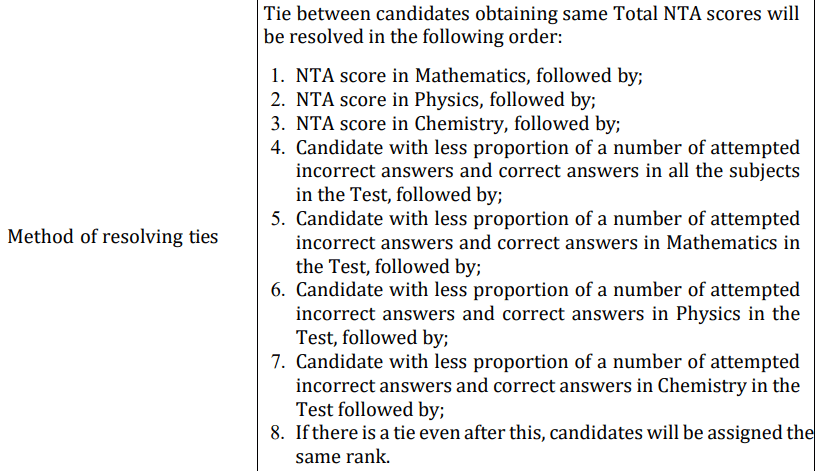
JEE Main 2026 Tie-Breaking Criteria
NTA uses a tie-breaking criterion to decide ranks if 2 or more candidates secure the same NTA percentile. The rules specified by NTA are given below:
Higher NTA score in Mathematics
Higher NTA score in Physics (if tie persists)
Higher NTA score in Chemistry (if tie remains)
Lower ratio of incorrect to correct answers (overall across all subjects)
Lower ratio of incorrect to correct answers in Mathematics
Lower ratio of incorrect to correct answers in Physics
Lower ratio of incorrect to correct answers in Chemistry
If there is a tie even after this, then the candidates will be assigned the same rank.
Source: JEE Main Official Information Bulletin
JEE Main College Predictor as per your rank
With the JEE Main College Predictor, you can estimate the college and branches based on your AIR, Category, Home-state quota, and previous year JoSAA/CSAB Cutoffs.

JEE Main College Predictor 2026: Rank vs College
JEE Main AIR Range | College Name | Likely Branches |
|---|---|---|
Up to 1,000 | NIT Trichy | CSE, AI, ECE |
Up to 1,000 | NIT Surathkal | CSE, ECE |
Up to 1,000 | NIT Warangal | CSE |
1,000 – 5,000 | NIT Rourkela | CSE, ECE |
1,000 – 5,000 | NIT Calicut | CSE, ECE |
5,000 – 15,000 | NIT Jaipur | ECE, EE |
5,000 – 15,000 | IIIT Allahabad | IT, ECE |
15,000 – 30,000 | NIT Raipur | EE, Mechanical |
15,000 – 30,000 | IIIT Gwalior | IT, ECE |
30,000 – 60,000 | NIT Srinagar | Civil, Mechanical |
30,000 – 60,000 | NIT Agartala | EE, Civil |
60,000 – 1,00,000 | PEC Chandigarh | Civil, Mechanical |
1,00,000+ | State Govt / Private Colleges | Branch varies |
Check: JEE Main College Predictor 2026
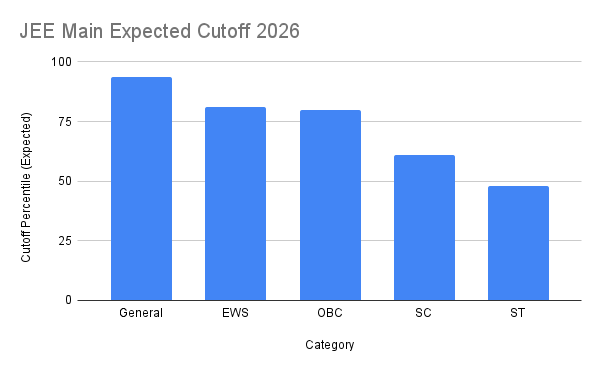
JEE Main 2026 Expected Cutoff Percentile: Category-wise
The JEE Main cutoff 2026 is expected to be a little higher than 2025 due to an increase in the number of candidates participating in the exam.
The UR category cutoff is expected to be around 93.5, while the cutoff for SC & ST categories is expected to be around 61 and 48, respectively.
Cutoff for the OBC and EWS categories will be around 80 & 81, respectively.
Category | Cutoff Percentile (Expected) |
|---|---|
General | 93.5 |
EWS | 81 |
OBC | 80 |
SC | 61 |
ST | 48 |