


Exam Preparation
Exam Pattern
The GRE General Test assesses candidates through a variety of question formats designed to measure verbal reasoning, quantitative reasoning, and analytical writing skills. Each question type evaluates different abilities, such as reading comprehension, logical reasoning, vocabulary usage, mathematical problem-solving, and data interpretation.
Here’s a breakdown of the GRE exam pattern:
Measure | Questions | Time |
|---|---|---|
Analytical Writing | 1 task | 30 min |
Verbal Reasoning Section 1 | 12 | 18 min |
Verbal Reasoning Section 2 | 15 | 23 min |
Quantitative Reasoning Section 1 | 12 | 21 min |
Quantitative Reasoning Section 2 | 15 | 26 min |
Note: GRE At-Home is not available in India. Applicants need to appear for the Computer-based exam only.
Also read: Check Upcoming GRE Exam Dates 2026
GRE Exam Pattern 2026: Overview
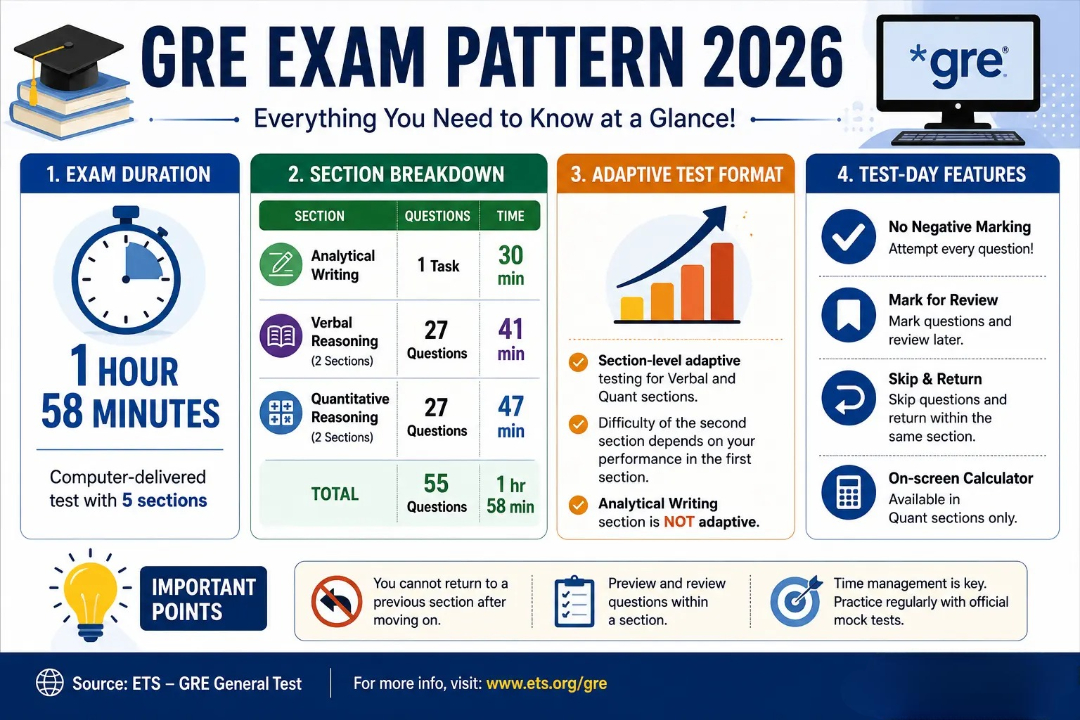
The GRE General Test is a computer-delivered standardized exam that measures a candidate's Verbal Reasoning, Quantitative Reasoning, Critical Thinking, and Analytical Writing skills. The current GRE General Test takes approximately 1 hour 58 minutes to complete.
Here’s an overview of the GRE:
Feature | Details |
|---|---|
Test Mode | Computer-delivered |
Total Duration | Approximately 1 hour 58 minutes |
Total Sections | 5 |
Analytical Writing | 1 section |
Verbal Reasoning | 2 sections |
Quantitative Reasoning | 2 sections |
Adaptive Format | Section-level adaptive |
Also read: Check GRE Exam Syllabus 2026
GRE Section-wise Exam Pattern 2026
GRE exam has 3 major sections: Analytical Writing, Verbal Reasoning, and Quantitative Reasoning. The sections below describe the exam pattern of the 3 GRE sections.
Analytical Writing
The Analytical Writing section measures your ability to think critically and communicate ideas clearly. It consists of one "Analyze an Issue" essay task in which you present and support your perspective with logical reasoning.
Component | Details |
|---|---|
Tasks | 1 |
Time | 30 minutes |
Skills Tested | Critical thinking, analytical writing, logical reasoning |
Verbal Reasoning
The Verbal Reasoning section evaluates your ability to understand written material, analyze arguments, interpret information, and apply vocabulary in context through Reading Comprehension, Text Completion, and Sentence Equivalence questions.
Section | Questions | Time |
|---|---|---|
Section 1 | 12 | 18 minutes |
Section 2 | 15 | 23 minutes |
Quantitative Reasoning
The Quantitative Reasoning section assesses your mathematical reasoning and problem-solving skills using concepts from arithmetic, algebra, geometry, and data analysis through various quantitative question types.
Section | Questions | Time |
|---|---|---|
Section 1 | 12 | 21 minutes |
Section 2 | 15 | 26 minutes |
GRE Question Types Explained 2026
According to ETS, the GRE General Test includes 3 Verbal Reasoning question types, 4 Quantitative Reasoning question types, and 1 Analytical Writing task. The tables below break down the question types in Verbal Reasoning and Quantitative Reasoning.
Verbal Reasoning Question Types 2026
Question Type | What You Need to Do | Skills Tested |
|---|---|---|
Reading Comprehension | Read passages and answer questions | Reading, inference, analysis |
Text Completion | Fill one, two, or three blanks in a passage | Vocabulary and context |
Sentence Equivalence | Select two answers that create equivalent meanings | Vocabulary and logical reasoning |
Quantitative Reasoning Question Types 2026
Question Type | What You Need to Do | Skills Tested |
|---|---|---|
Quantitative Comparison | Compare Quantity A and Quantity B | Mathematical reasoning |
Multiple Choice (Single Answer) | Choose one correct answer | Problem-solving |
Multiple Choice (Multiple Answers) | Select all correct answers | Analytical thinking |
Numeric Entry | Enter the calculated answer | Numerical accuracy |
Data Interpretation | Answer questions based on tables or graphs | Data analysis |
GRE Adaptive Test Pattern 2026: How Does It Work?
The GRE uses section-level adaptive testing for the Verbal Reasoning and Quantitative Reasoning measures. The difficulty of the second Verbal and second Quant section depends on your performance in the first section of that measure.
Stage | What Happens |
|---|---|
First Verbal/Quant Section | All candidates receive a section of average difficulty. |
Performance Evaluation | ETS evaluates your overall performance in the first section. |
Second Verbal/Quant Section | You receive an easier or more difficult second section based on your performance. |
Final Score | Based on the total number of correct answers and the difficulty level of the second section. |
GRE features you must know, which can help you while giving the exam:
Preview and review questions within a section.
Skip questions and answer them later.
Mark questions for review.
Change answers before the section time ends.
Use an on-screen calculator in the Quantitative Reasoning sections.
Important pointers:
The Analytical Writing section is not adaptive.
You cannot return to a previous section after moving on.
There is no negative marking, so ETS recommends attempting every question.
Common GRE Preparation Mistakes and How to Avoid Them
Indian applicants appearing for the GRE must be careful not to make these mistakes during their exam. Check the common mistakes most of the candidates make, along with the solutions:
Common Mistake | Solution |
|---|---|
Spending too much time on one question | Set a time limit for each question and use the Mark for Review feature to revisit difficult ones later. |
Leaving questions unanswered | Attempt every question, as the GRE has no negative marking. |
Ignoring weak areas | Analyze mock test results and dedicate extra study time to sections where you score the lowest. |
Not practicing under timed conditions | Take full-length, timed practice tests to improve speed and time management. |
Relying only on vocabulary memorization | Practice Reading Comprehension, Text Completion, and Sentence Equivalence questions to apply vocabulary in context. |
Skipping Analytical Writing practice | Write timed essays regularly and review the ETS scoring criteria to improve organization and argument development. |
GRE Preparation Tips for Indian Students 2026
Applicants appearing for the GRE must follow these tips to score well in their exam:
Understand the exam format: Familiarize yourself with the GRE pattern, question types, and section timings before starting your preparation.
Practice with official mock tests: Take full-length ETS practice tests to build accuracy, speed, and confidence.
Create a study plan: Allocate dedicated time each week for Verbal Reasoning, Quantitative Reasoning, and Analytical Writing.
Review your mistakes: Analyze incorrect answers after every practice test to identify weak areas and improve performance.
Improve time management: Practice answering questions within the allotted time to avoid rushing during the actual exam.
Strengthen fundamentals: Revise core math concepts and build vocabulary through regular reading and practice.
GRE Preparation Books 2026: Download Free PDF
The best way to prepare for the GRE is through GRE prep books, including Manhattan Prep GRE, Kaplan GRE prep, and Magoosh GRE prep. Check out the PDF versions below:
The GRE General Test is a 1 hour 58 minute, computer-delivered exam with five sections, including one Analytical Writing section, two Verbal Reasoning sections, and two Quantitative Reasoning sections. Understanding the exam pattern, section-level adaptive format, and question types can help you prepare more effectively. Since the GRE has no negative marking and allows you to review questions within a section, practicing with timed mock tests and following a structured study plan can improve your overall performance.