

Exam Pattern and Syllabus
NID DAT Syllabus and Topics
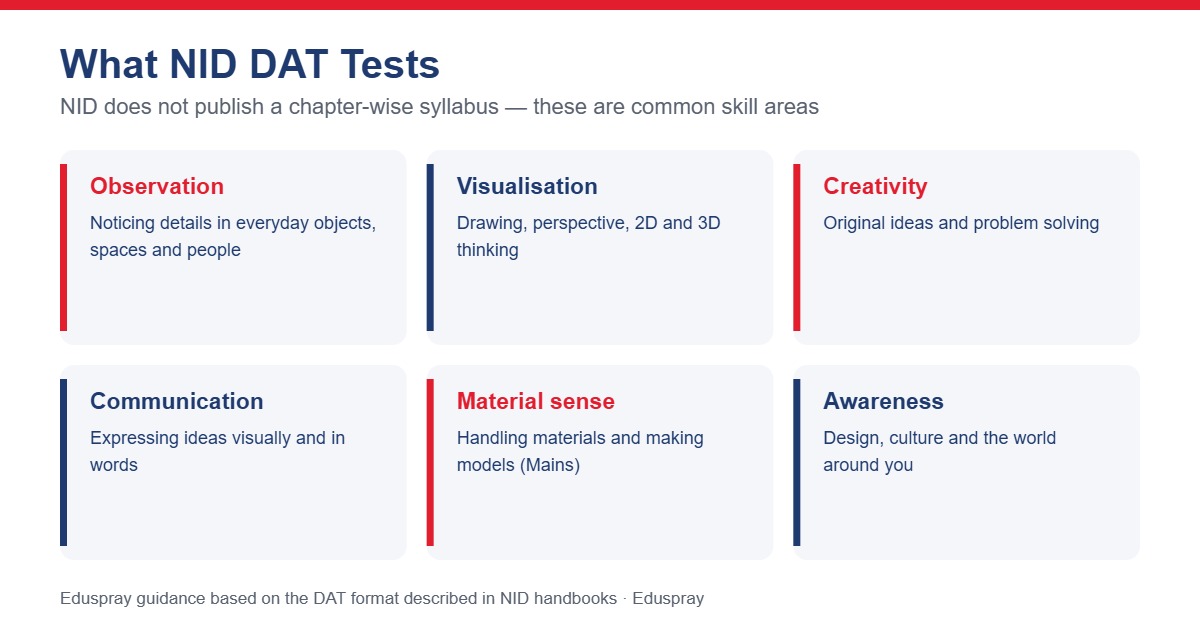
NID does not publish a chapter-wise syllabus. The DAT is designed to assess design aptitude — how you observe, think, imagine and communicate. Based on the format in the handbook (text and visual questions in Prelims; studio and in-person tests in Mains), these are the core skills to build.
Skills Commonly Tested
Skill | What it looks like in practice |
|---|---|
Observation | Noticing details, proportions, patterns and behaviour in everyday life |
Visual thinking and drawing | Sketching objects and scenes, perspective, light and shade, 2D and 3D representation |
Creativity and ideation | Generating several original ideas for a problem or theme |
Visual communication | Explaining ideas through drawings, symbols and layouts |
Language and reasoning | Understanding questions, analysing situations and writing clearly |
Material and spatial sense | Handling materials, building simple models and thinking in 3D (Mains) |
General and design awareness | Awareness of design, art, craft, culture and current issues |
Prelims vs Mains
Prelims: Mix of text and visual questions answered on paper.
Mains (UG): Studio Sensitivity Test and In-Person Sensitivity Test — hands-on and interaction-based.
Mains (M.Des): Studio Test and a discipline-specific Interview.
Key Takeaways
No official chapter-wise syllabus.
Focus on observation, drawing, creativity and communication.
Mains tests hands-on and interpersonal design sensitivity.
Pro Tip: Carry a small sketchbook everywhere and draw what you see for 15 minutes daily. Observation is the foundation of every NID DAT task.
Source: Eduspray guidance based on the DAT format in the NID Admissions Handbooks 2027-28
Frequently Asked Questions
Does NID publish a DAT syllabus?
No. NID describes the test format but does not publish a chapter-wise syllabus.
Is drawing important for NID DAT?
Yes. Visual questions and studio tests make sketching and visual communication important.
Is there a separate syllabus for M.Des?
No fixed syllabus; the Studio Test and Interview are discipline-focused, so prepare according to your chosen disciplines.