CSIR NET Subjects and Career Options
Full pageCSIR NET is offered in five science subjects. Your choice should match your postgraduate specialisation and the research area you want to pursue. Here is what each subject covers and where it can lead.
The Five CSIR NET Subjects
Code | Subject | Typical background | Research areas |
|---|---|---|---|
701 | Chemical Sciences | M.Sc. Chemistry and allied areas | Inorganic, organic, physical, analytical, materials, medicinal and green chemistry |
702 | Earth, Atmospheric, Ocean and Planetary Sciences | M.Sc. Geology, Geophysics, Meteorology, Oceanography, Geography and allied areas | Geology, geophysics, climate and atmospheric science, ocean science, planetary science |
703 | Life Sciences and Bio-Technology | M.Sc. Life Sciences, Biotechnology, Botany, Zoology, Microbiology, Biochemistry and allied areas | Molecular and cell biology, genetics, immunology, plant and animal sciences, ecology, biotechnology, bioinformatics |
704 | Mathematical Sciences | M.Sc. Mathematics, Statistics and allied areas | Pure and applied mathematics, statistics, operations research |
705 | Physical Sciences | M.Sc. Physics and allied areas | Condensed matter, nuclear and particle, atomic and molecular, theoretical and applied physics |
Career Paths After CSIR NET
Path | How CSIR NET helps |
|---|---|
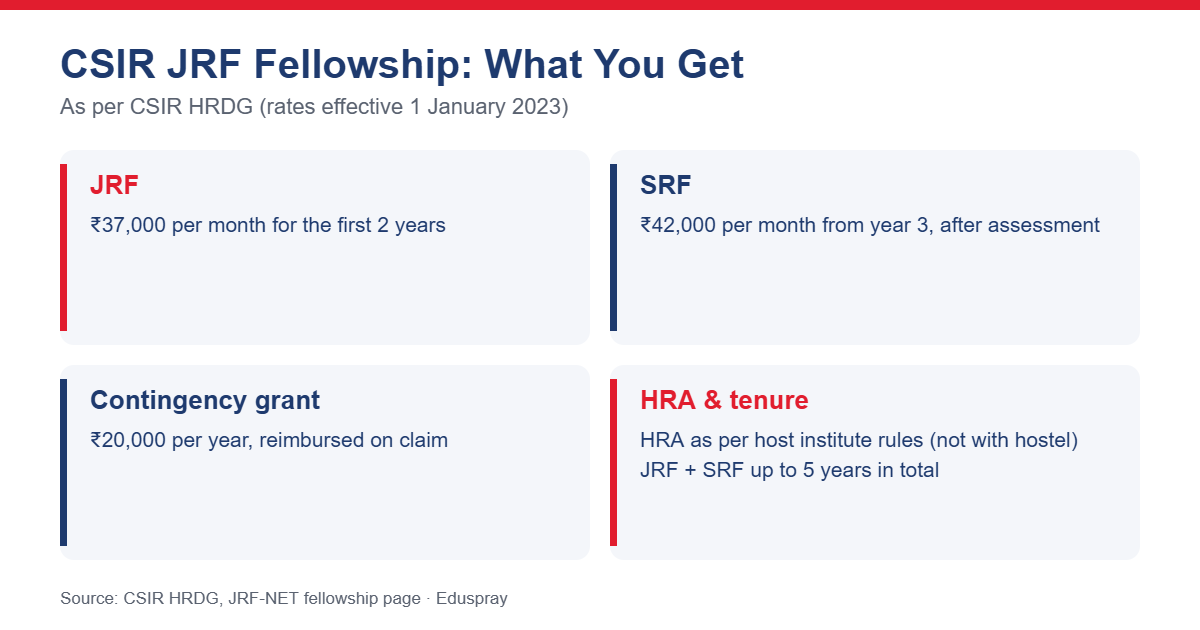
PhD with fellowship (JRF) | JRF holders receive ₹37,000 per month for two years and may move to SRF at ₹42,000 per month, plus a ₹20,000 annual contingency grant |
Assistant Professor | Category 1 and 2 qualifiers are eligible for appointment as Assistant Professor in Indian universities and colleges, subject to the recruiting body’s rules |
PhD admission without fellowship | Category 2 and 3 scores can replace university entrance tests for PhD admission |
Research at national laboratories | Fellowships can be held at CSIR laboratories and other recognised research establishments |
Industry R&D | Fellowships can also be held at R&D establishments of recognised public or private sector industrial firms |
Which Subject Should You Choose?
Pick the subject of your Master’s degree unless your research goal is clearly in another area.
Four-year bachelor’s degree holders may choose the subject in which they want to do a PhD, irrespective of their undergraduate discipline.
Look at subject-wise cutoffs and competition: Life Sciences has the largest pool, Earth Sciences the smallest.
Key Takeaways
Five subjects: Chemical, Earth, Life Sciences & Biotech, Mathematical and Physical Sciences.
Outcomes: funded PhD, Assistant Professor eligibility, PhD admission.
Fellowships can be held in universities, IITs, CSIR labs and recognised industrial R&D units.
Pro Tip: Before choosing your subject, shortlist 5–10 research groups you would like to join and check which NET subject their past students qualified in.
Source: Joint CSIR-UGC NET December 2026 Information Bulletin (Sections 1.5–1.8, Annexure II), NTA / CSIR
Frequently Asked Questions
How many subjects are there in CSIR NET?
Five: Chemical Sciences; Earth, Atmospheric, Ocean and Planetary Sciences; Life Sciences and Bio-Technology; Mathematical Sciences; and Physical Sciences.
What can I do after qualifying CSIR NET?
Pursue a funded PhD as JRF, become eligible for Assistant Professor posts, or use the score for PhD admission.
Can a 4-year degree holder choose any CSIR NET subject?
Yes. They may choose the subject in which they want to pursue a PhD, irrespective of their undergraduate discipline.