
Eduspray
HomeExamsCSIR NETExam Pattern and Syllabus
CSIR NET
Entrance Exam

CSIR NET

National Testing Agency (NTA) for CSIR

Joint CSIR-UGC NET December 2026 by NTA decides JRF fellowships, Assistant Professor eligibility and PhD admission in five science subjects. Check dates, eligibility, age limit, pattern, syllabus, fees, cutoffs and results.

CSIR NETCSIR NET December 2026Joint CSIR UGC NETCSIR NET JRFCSIR NET Life SciencesNTA CSIR NET

Last updated: 16 Oct 2026

HomeExamsCSIR NETExam Pattern and Syllabus

Exam Pattern and Syllabus

Updated 16 Oct 20263 topics

CSIR NET Exam Pattern

Full page

CSIR NET is a 3-hour computer-based test with three parts — A, B and C — and no break between them. All questions are objective multiple-choice questions. The total is 200 marks for every subject, but the number of questions, marks per question and negative marking differ by subject. The tables below are from the December 2026 Information Bulletin.
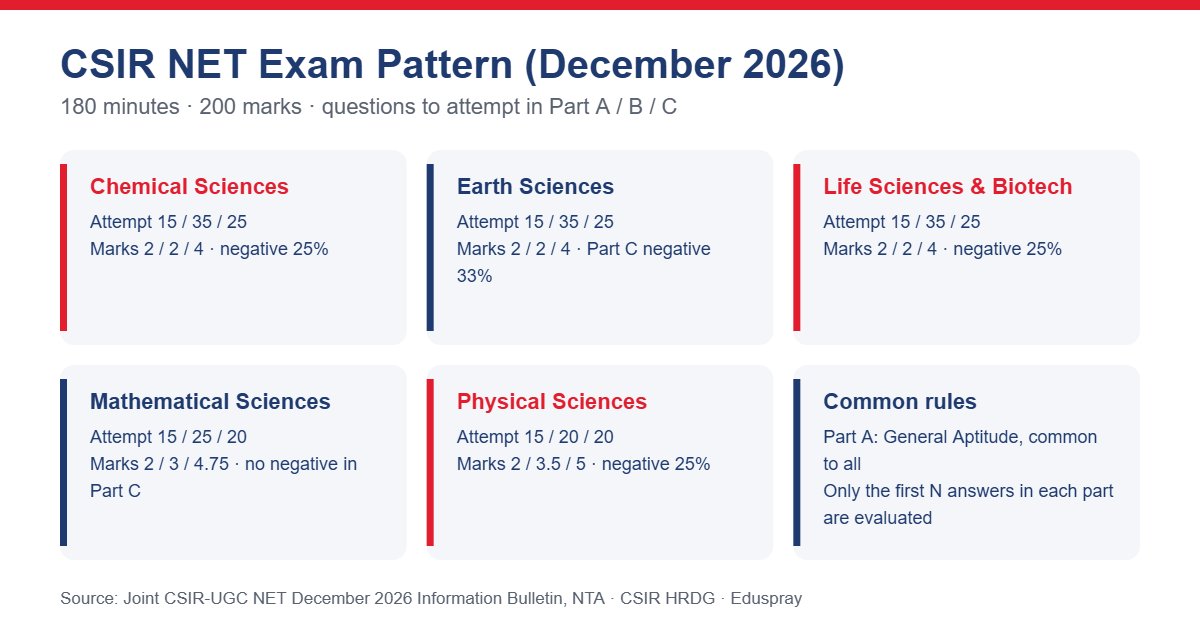
CSIR NET exam pattern for all five subjects

The Three Parts at a Glance

Part

What it tests

Part A

Common to all subjects: General Aptitude — logical reasoning, graphical analysis, analytical and numerical ability, quantitative comparison, series formation, puzzles

Part B

Subject-related conventional MCQs covering the topics in the syllabus

Part C

Higher-order questions testing knowledge of scientific concepts and their application — analytical in nature

Chemical Sciences (701)

Part A

Part B

Part C

Total

Total questions

20

40

60

120

Max. questions to attempt

15

35

25

75

Marks per correct answer

2

2

4

200

Negative marks per wrong answer

0.5

0.5

1

—

Negative marking is 25% in Parts A, B and C.

Earth, Atmospheric, Ocean and Planetary Sciences (702)

Part A

Part B

Part C

Total

Total questions

20

50

80

150

Max. questions to attempt

15

35

25

75

Marks per correct answer

2

2

4

200

Negative marks per wrong answer

0.5

0.5

1.32

—

Negative marking is 25% in Parts A and B and 33% in Part C.

Life Sciences and Bio-Technology (703)

Part A

Part B

Part C

Total

Total questions

20

50

75

145

Max. questions to attempt

15

35

25

75

Marks per correct answer

2

2

4

200

Negative marks per wrong answer

0.5

0.5

1

—

Negative marking is 25% in Parts A, B and C.

Mathematical Sciences (704)

Part A

Part B

Part C

Total

Total questions

20

40

60

120

Max. questions to attempt

15

25

20

60

Marks per correct answer

2

3

4.75

200

Negative marks per wrong answer

0.5

0.75

0

—

Negative marking is 25% in Parts A and B; no negative marking in Part C. In Part C, a question may have one or more correct options, and credit is given only if all correct options are identified.

Physical Sciences (705)

Part A

Part B

Part C

Total

Total questions

20

25

30

75

Max. questions to attempt

15

20

20

55

Marks per correct answer

2

3.5

5

200

Negative marks per wrong answer

0.5

0.875

1.25

—

Negative marking is 25% in Parts A, B and C.

Rules Every Candidate Must Know

  • Only the first N answers count: If you answer more than the maximum number of questions in a part, only the first 15 (Part A), first 35/25/20 (Part B) and first 25/20 (Part C), as applicable, are evaluated.

  • Choose wisely: Because you answer only some of the questions, picking the ones you are sure about matters as much as solving them.

  • Medium: The paper is bilingual (English and Hindi). If there is any difference between versions, the English version is final.

  • Physical Sciences: Part B questions are drawn from the core syllabus (Part I), and Part C from both the core and advanced syllabus.

Key Takeaways

  • 180 minutes, 200 marks, Parts A, B and C, CBT mode.

  • Part A (General Aptitude) is common to all subjects: attempt 15 of 20, 2 marks each.

  • Negative marking is 25% in most parts; 33% in Earth Sciences Part C; none in Maths Part C.

  • Only the first N attempted answers in each part are evaluated.

Pro Tip: Do not attempt extra questions “just in case”. Since only the first N answers are evaluated, answering more can mean your best answers are ignored.

Source: Joint CSIR-UGC NET December 2026 Information Bulletin, Chapter 3 (Scheme of Examination), NTA; CSIR HRDG scheme pages

Frequently Asked Questions

How many marks is the CSIR NET exam?

200 marks in 180 minutes, divided into Parts A, B and C.

Is Part A common for all CSIR NET subjects?

Yes. Part A is General Aptitude: attempt 15 of 20 questions, 2 marks each, with 0.5 negative marks.

What happens if I answer more questions than allowed?

Only the first N answers in each part are evaluated, so extra answers can mean your best ones are ignored.
CSIR NET exam patternCSIR NET marking scheme

CSIR NET Syllabus

Full page

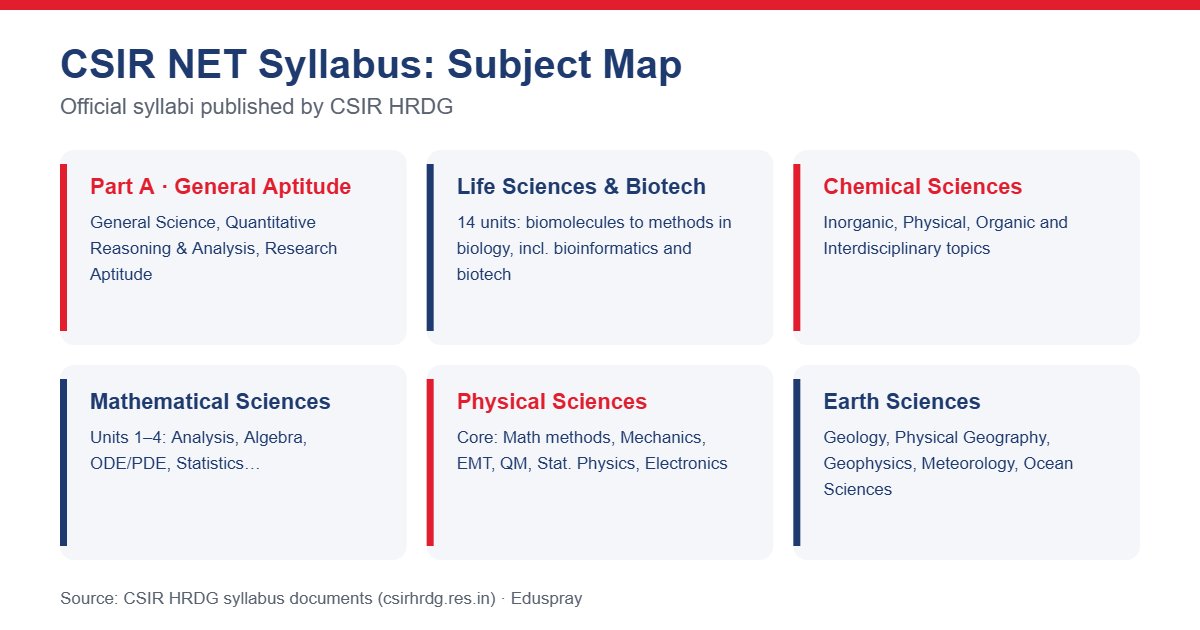
The CSIR NET syllabus for each subject is published by the CSIR Human Resource Development Group (csirhrdg.res.in). Part A (General Aptitude) is common to all subjects, while Parts B and C follow the subject syllabus at the postgraduate level. Here is a structured overview of every subject.

CSIR NET syllabus subject map

Part A: General Aptitude (All Subjects)

  • General Science

  • Quantitative Reasoning and Analysis

  • Research Aptitude

  • Logical reasoning, graphical analysis, analytical and numerical ability, series formation and puzzles

Life Sciences and Bio-Technology (703) — Revised 14-Unit Syllabus

From December 2026, the merged CSIR-DBT syllabus applies:

  1. Structure and Function of Biomolecules

  2. Cellular Organization

  3. Fundamental Processes

  4. Cell Communication and Cell Signaling

  5. Developmental Biology

  6. System Physiology – Plant

  7. System Physiology – Animal

  8. Inheritance Biology

  9. Evolution and Diversity of Life Forms

  10. Ecology and Behavioural Biology

  11. Bioinformatics and Computational Biology

  12. Biochemical Engineering and Industrial Biotechnology

  13. Advances in Biotechnology

  14. Methods in Biology

Earlier cycles used a 13-unit Life Sciences syllabus. Use the revised syllabus for December 2026 and later.

Chemical Sciences (701)

Area

Main topics

Inorganic Chemistry

Periodicity; structure and bonding (VSEPR); acids and bases; main group elements; transition elements and coordination compounds; inner transition elements; organometallics; cages and clusters; analytical chemistry; bioinorganic chemistry; spectroscopic characterisation; nuclear chemistry

Physical Chemistry

Quantum mechanics and approximate methods; atomic structure and spectroscopy; chemical bonding; group theory; molecular spectroscopy; thermodynamics and statistical thermodynamics; electrochemistry; chemical kinetics; colloids and surfaces; solid state; polymer chemistry; data analysis

Organic Chemistry

Nomenclature; stereochemistry; aromaticity; reactive intermediates; reaction mechanisms; named reactions and rearrangements; functional group transformations; synthesis concepts; asymmetric synthesis; pericyclic and photochemical reactions; heterocycles; natural products; structure determination

Interdisciplinary Topics

Nanoscience; catalysis and green chemistry; medicinal chemistry; supramolecular chemistry; environmental chemistry

Mathematical Sciences (704)

Unit

Topics

Unit 1

Analysis; Linear Algebra

Unit 2

Complex Analysis; Algebra; Topology

Unit 3

Ordinary Differential Equations; Partial Differential Equations; Numerical Analysis; Calculus of Variations; Linear Integral Equations; Classical Mechanics

Unit 4

Descriptive Statistics and Probability; Stochastic Processes; Statistical Inference; Linear Models and Multivariate Analysis; Sampling and Design of Experiments; Reliability, Operations Research and Queuing

Physical Sciences (705)

Syllabus part

Topics

Part I (Core)

Mathematical Methods of Physics; Classical Mechanics; Electromagnetic Theory; Quantum Mechanics; Thermodynamic and Statistical Physics; Electronics and Experimental Methods

Part II (Advanced)

Advanced levels of the six core areas, plus Atomic and Molecular Physics; Condensed Matter Physics; Nuclear and Particle Physics

Exam Part B questions come from the core syllabus; Part C questions come from both the core and advanced syllabus.

Earth, Atmospheric, Ocean and Planetary Sciences (702)

Section

Topics

General (Part B)

The Earth and the Solar System; Earth Materials, Surface Features and Processes; Interior of the Earth, Deformation and Tectonics; Oceans and Atmosphere; Environmental Earth Sciences

Specialised (Part C)

Geology; Physical Geography; Geophysics; Meteorology; Ocean Sciences

Key Takeaways

  • Part A General Aptitude is common across subjects and worth 30 marks.

  • Life Sciences and Bio-Technology has a revised 14-unit syllabus from December 2026.

  • Always download the latest syllabus PDF from csirhrdg.res.in before you start.

Pro Tip: Map past question papers to the syllabus units. You will quickly see which units carry the most questions in your subject and where to invest your time.

Source: CSIR HRDG syllabus documents for each subject (csirhrdg.res.in), including the merged CSIR-DBT Life Sciences and Bio-Technology syllabus (21.01.2026)

Frequently Asked Questions

Has the CSIR NET Life Sciences syllabus changed?

Yes. From December 2026, Life Sciences is merged with DBT-BET as Life Sciences and Bio-Technology, with a revised 14-unit syllabus.

Where can I download the official CSIR NET syllabus?

From the CSIR HRDG website, csirhrdg.res.in.

What topics are in CSIR NET Part A?

General Science, Quantitative Reasoning and Analysis, and Research Aptitude, including logical reasoning, graphical analysis and puzzles.

CSIR NET syllabusCSIR NET Life Sciences syllabus

CSIR NET Preparation Tips

Full page

CSIR NET tests deep conceptual understanding at the postgraduate level, along with speed, accuracy and smart question selection. Because only a few thousand candidates get JRF each cycle, a planned approach makes a big difference.

1. Understand the Scoring Game

  • Part A (30 marks) is the easiest place to score: attempt 15 of 20 general aptitude questions. A strong Part A can lift you above the cutoff.

  • Part C carries the most marks (100 marks in every subject). It decides JRF ranks.

  • Negative marking is 25% in most parts (33% in Earth Sciences Part C), so guess only when you can eliminate options.

  • Mathematical Sciences Part C has no negative marking but needs all correct options for credit.

2. Subject-wise Focus Areas

Subject

Where to focus

Life Sciences & Biotech

Molecular biology, cell biology, genetics, biochemistry, methods in biology; new biotech units (bioinformatics, industrial biotech, advances in biotech)

Chemical Sciences

Physical chemistry numericals, organic reaction mechanisms and spectroscopy, coordination chemistry and group theory

Mathematical Sciences

Real analysis and linear algebra (Unit 1) form the base; add algebra, complex analysis, ODE/PDE and statistics as per your strength

Physical Sciences

Mathematical methods, quantum mechanics, electromagnetic theory, statistical physics; numerical practice for Part C

Earth Sciences

Core Part B topics plus one Part C specialisation (Geology, Geophysics, Meteorology, Ocean Sciences or Physical Geography)

3. A 6-Month Preparation Plan

Phase

What to do

Months 1–2

Revise the full syllabus from standard PG textbooks; make short notes per unit

Months 3–4

Solve previous years’ papers unit-wise; daily Part A aptitude practice (20–30 minutes)

Month 5

Full-length 3-hour mock tests twice a week; analyse accuracy and question selection

Final month

Revise notes, formula sheets and weak units; one mock every 2–3 days in exam time slots

4. Exam-Day Strategy

  • Start with Part A to settle in, but limit it to about 25–30 minutes.

  • In Part B, attempt questions you are confident about first; skip lengthy ones.

  • In Part C, read all questions once, then select your best 25 (or 20) — quality over quantity.

  • Track the number of questions attempted in each part so you do not exceed the evaluated limit.

5. Recommended Resources

  • Official syllabus and previous question papers from csirhrdg.res.in and the NTA website

  • Standard postgraduate textbooks for your subject

  • NTA mock tests and timed practice papers

  • A personal error log of mistakes from every mock test

Key Takeaways

  • Part A is high-scoring — practise aptitude every day.

  • Part C (100 marks) decides JRF; build depth in core units.

  • Accuracy matters: negative marking applies in most parts.

  • Analyse every mock for both mistakes and question selection.

Pro Tip: Look at the previous cycle’s cutoffs for your subject. For example, the June 2026 JRF cutoff (UR) was 66.5% in Life Sciences but 43% in Mathematical Sciences — set your target score accordingly.

Need Help with CSIR NET and PhD Admissions?

Not sure which subject to choose, how to plan for JRF, or where to apply for a PhD with your NET score? Eduspray’s counsellors can help you plan your preparation and research career. Reach out to the Eduspray team for personalised guidance.

Frequently Asked Questions

How many months are needed to prepare for CSIR NET?

It depends on your base, but a focused plan of about six months — syllabus revision, previous papers and full mock tests — works well for many students.

Which part decides the JRF rank?

Part C carries 100 marks in every subject and has the biggest impact on your rank.

Should I guess answers in CSIR NET?

Only when you can eliminate options. Negative marking is 25% in most parts (33% in Earth Sciences Part C), but there is none in Mathematical Sciences Part C.

CSIR NET preparationCSIR NET strategy