

Exam Pattern and Syllabus
CSIR NET Syllabus
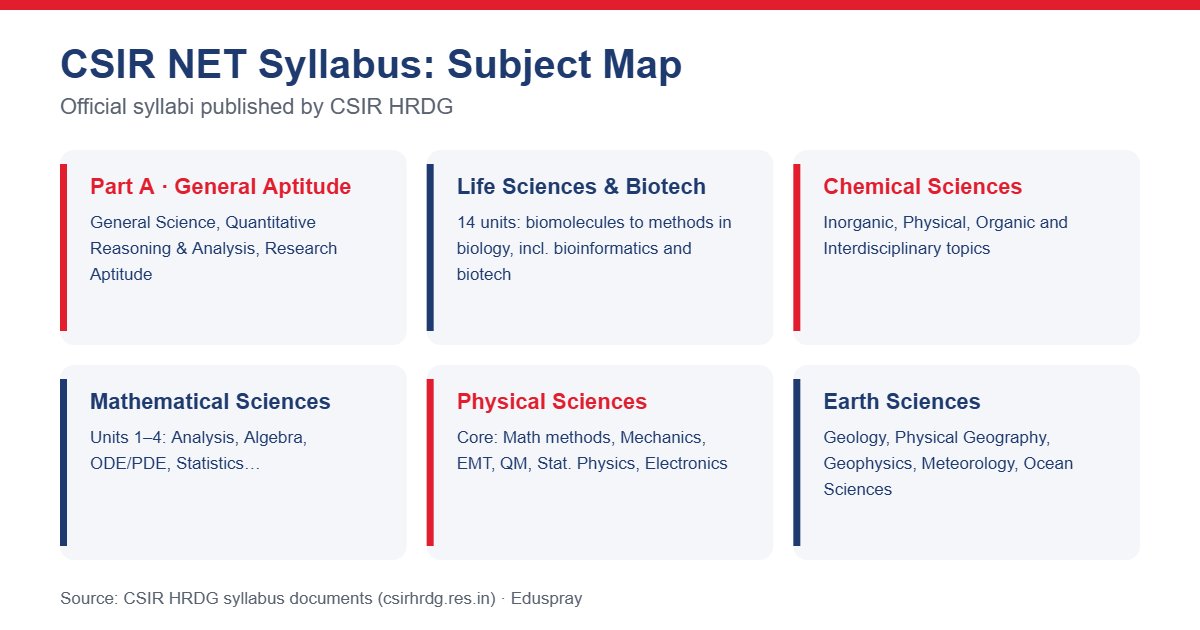
The CSIR NET syllabus for each subject is published by the CSIR Human Resource Development Group (csirhrdg.res.in). Part A (General Aptitude) is common to all subjects, while Parts B and C follow the subject syllabus at the postgraduate level. Here is a structured overview of every subject.
Part A: General Aptitude (All Subjects)
General Science
Quantitative Reasoning and Analysis
Research Aptitude
Logical reasoning, graphical analysis, analytical and numerical ability, series formation and puzzles
Life Sciences and Bio-Technology (703) — Revised 14-Unit Syllabus
From December 2026, the merged CSIR-DBT syllabus applies:
Structure and Function of Biomolecules
Cellular Organization
Fundamental Processes
Cell Communication and Cell Signaling
Developmental Biology
System Physiology – Plant
System Physiology – Animal
Inheritance Biology
Evolution and Diversity of Life Forms
Ecology and Behavioural Biology
Bioinformatics and Computational Biology
Biochemical Engineering and Industrial Biotechnology
Advances in Biotechnology
Methods in Biology
Earlier cycles used a 13-unit Life Sciences syllabus. Use the revised syllabus for December 2026 and later.
Chemical Sciences (701)
Area | Main topics |
|---|---|
Inorganic Chemistry | Periodicity; structure and bonding (VSEPR); acids and bases; main group elements; transition elements and coordination compounds; inner transition elements; organometallics; cages and clusters; analytical chemistry; bioinorganic chemistry; spectroscopic characterisation; nuclear chemistry |
Physical Chemistry | Quantum mechanics and approximate methods; atomic structure and spectroscopy; chemical bonding; group theory; molecular spectroscopy; thermodynamics and statistical thermodynamics; electrochemistry; chemical kinetics; colloids and surfaces; solid state; polymer chemistry; data analysis |
Organic Chemistry | Nomenclature; stereochemistry; aromaticity; reactive intermediates; reaction mechanisms; named reactions and rearrangements; functional group transformations; synthesis concepts; asymmetric synthesis; pericyclic and photochemical reactions; heterocycles; natural products; structure determination |
Interdisciplinary Topics | Nanoscience; catalysis and green chemistry; medicinal chemistry; supramolecular chemistry; environmental chemistry |
Mathematical Sciences (704)
Unit | Topics |
|---|---|
Unit 1 | Analysis; Linear Algebra |
Unit 2 | Complex Analysis; Algebra; Topology |
Unit 3 | Ordinary Differential Equations; Partial Differential Equations; Numerical Analysis; Calculus of Variations; Linear Integral Equations; Classical Mechanics |
Unit 4 | Descriptive Statistics and Probability; Stochastic Processes; Statistical Inference; Linear Models and Multivariate Analysis; Sampling and Design of Experiments; Reliability, Operations Research and Queuing |
Physical Sciences (705)
Syllabus part | Topics |
|---|---|
Part I (Core) | Mathematical Methods of Physics; Classical Mechanics; Electromagnetic Theory; Quantum Mechanics; Thermodynamic and Statistical Physics; Electronics and Experimental Methods |
Part II (Advanced) | Advanced levels of the six core areas, plus Atomic and Molecular Physics; Condensed Matter Physics; Nuclear and Particle Physics |
Exam Part B questions come from the core syllabus; Part C questions come from both the core and advanced syllabus.
Earth, Atmospheric, Ocean and Planetary Sciences (702)
Section | Topics |
|---|---|
General (Part B) | The Earth and the Solar System; Earth Materials, Surface Features and Processes; Interior of the Earth, Deformation and Tectonics; Oceans and Atmosphere; Environmental Earth Sciences |
Specialised (Part C) | Geology; Physical Geography; Geophysics; Meteorology; Ocean Sciences |
Key Takeaways
Part A General Aptitude is common across subjects and worth 30 marks.
Life Sciences and Bio-Technology has a revised 14-unit syllabus from December 2026.
Always download the latest syllabus PDF from csirhrdg.res.in before you start.
Pro Tip: Map past question papers to the syllabus units. You will quickly see which units carry the most questions in your subject and where to invest your time.
Source: CSIR HRDG syllabus documents for each subject (csirhrdg.res.in), including the merged CSIR-DBT Life Sciences and Bio-Technology syllabus (21.01.2026)
Frequently Asked Questions
Has the CSIR NET Life Sciences syllabus changed?
Yes. From December 2026, Life Sciences is merged with DBT-BET as Life Sciences and Bio-Technology, with a revised 14-unit syllabus.
Where can I download the official CSIR NET syllabus?
From the CSIR HRDG website, csirhrdg.res.in.
What topics are in CSIR NET Part A?
General Science, Quantitative Reasoning and Analysis, and Research Aptitude, including logical reasoning, graphical analysis and puzzles.