

Exam Pattern and Syllabus
Syllabus
NATA 2027 status (checked 15 October 2026): The Council of Architecture has not yet released the NATA 2027 information brochure. Wherever this page refers to NATA 2026, the information is from the previous cycle and is given for reference only. It may change for 2027.
Key Takeaways
NATA is an aptitude test, not a chapter-based syllabus.
Part A covers composition and colour, black-and-white sketching and 3D composition.
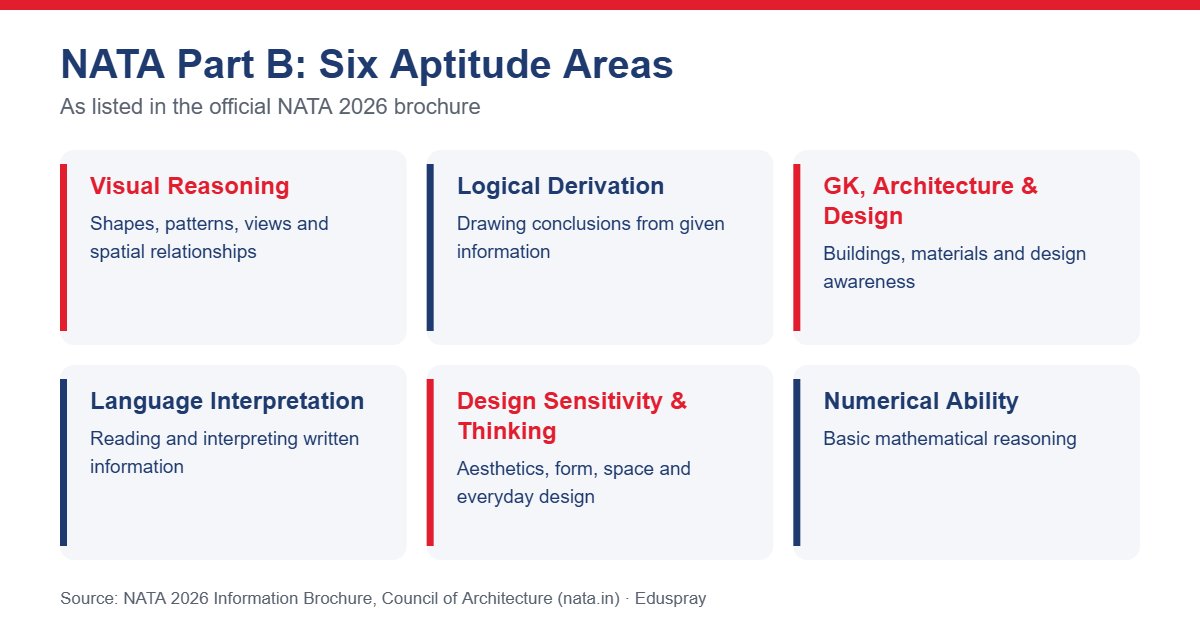
Part B covers six aptitude areas, from visual reasoning to numerical ability.
NATA 2027 Syllabus
NATA is an aptitude test, not a curriculum-based exam. Instead of testing specific chapters from school textbooks, it assesses how well candidates observe, visualise, draw, reason and think about design. The official NATA 2026 brochure lists the following areas. The NATA 2027 syllabus will be confirmed when the new brochure is released.
NATA Syllabus: Section-Wise Overview
Part | Section | Area |
|---|---|---|
Part A | A1 | Composition and Colour |
Part A | A2 | Sketching and Composition (Black and White) |
Part A | A3 | 3D Composition |
Part B | B1 and B2 | Visual Reasoning; Logical Derivation; General Knowledge, Architecture and Design; Language Interpretation; Design Sensitivity and Thinking; Numerical Ability |
1. Composition and Colour (A1)
This section tests the ability to create a balanced composition and use colour effectively to communicate an idea or theme.
2. Sketching and Composition in Black and White (A2)
This section tests freehand sketching, use of light and shade, proportion and the ability to represent a scene or idea in black and white.
3. 3D Composition (A3)
This section tests three-dimensional thinking. In 2026, candidates created a 3D composition using a kit provided at the centre.
4. Part B Aptitude Areas
Visual Reasoning
Understanding and interpreting shapes, patterns, views and spatial relationships.
Logical Derivation
Drawing conclusions from given information and solving reasoning problems.
General Knowledge, Architecture and Design
Awareness of architecture, design, buildings, materials and related general knowledge.
Language Interpretation
Reading and interpreting written information accurately.
Design Sensitivity and Thinking
Sensitivity to aesthetics, form, space and everyday design.
Numerical Ability
Basic mathematical reasoning and numerical problem-solving.
How to Prepare for the NATA Syllabus
Sketch daily from observation: streets, interiors, objects and people.
Practise colour compositions on different themes within a fixed time.
Build 3D models with simple materials to improve spatial thinking.
Solve visual and logical reasoning puzzles regularly.
Read about famous buildings, architects and design in India and abroad.
Revise Class 11–12 Mathematics basics for numerical questions.
Official NATA Syllabus Document
The official syllabus areas are listed in the NATA 2026 Information Brochure. The NATA 2027 syllabus will be linked here once released. See also the NATA Exam Pattern.
Pro Tip: Keep a sketchbook and spend at least 30 minutes a day drawing from observation. Regular practice builds speed and confidence for Part A.
Official Website
For the latest NATA information, refer to the official resources:
NATA website: https://www.nata.in
Council of Architecture: https://www.coa.gov.in
NATA 2026 information brochure (previous cycle): Download PDF
Candidates should verify every detail on the official website before registering or paying any fee.

Need Help with NATA Preparation?
Eduspray India can help students understand NATA requirements, shortlist architecture colleges and plan their admission applications. Use the College Predictor, compare colleges or explore top colleges in India.