Eduspray
HomeExamsNIFT /NIFTEEExam Pattern and Syllabus
NIFT /NIFTEE
Entrance Exam

NIFT /NIFTEE

National Testing Agency (NTA)

NIFT Entrance Exam (NIFTEE) 2027 by NTA is the gateway to B.Des, B.FTech, M.Des, MFM and MFTech at NIFT campuses. Check the tentative 10 January 2027 exam date, eligibility, pattern, fees, Situation Test, results and counselling.

NIFT 2027NIFTEE 2027NTA NIFTDesign Entrance ExamB.DesB.F.TechMFMM.F.Tech

Last updated: 16 Oct 2026

HomeExamsNIFT /NIFTEEExam Pattern and Syllabus

Exam Pattern and Syllabus

Updated 16 Oct 20263 topics

NIFT Exam Pattern

Full page

The NIFT entrance exam has different papers for different programmes. In 2026, the General Ability Test (GAT) was computer-based and the Creative Ability Test (CAT) was pen-and-paper. GAT has negative marking: +1 for a correct answer, −0.25 for a wrong answer and 0 for an unattempted question. The pattern below is from the NIFT 2026 Information Bulletin and Admission Guidelines.
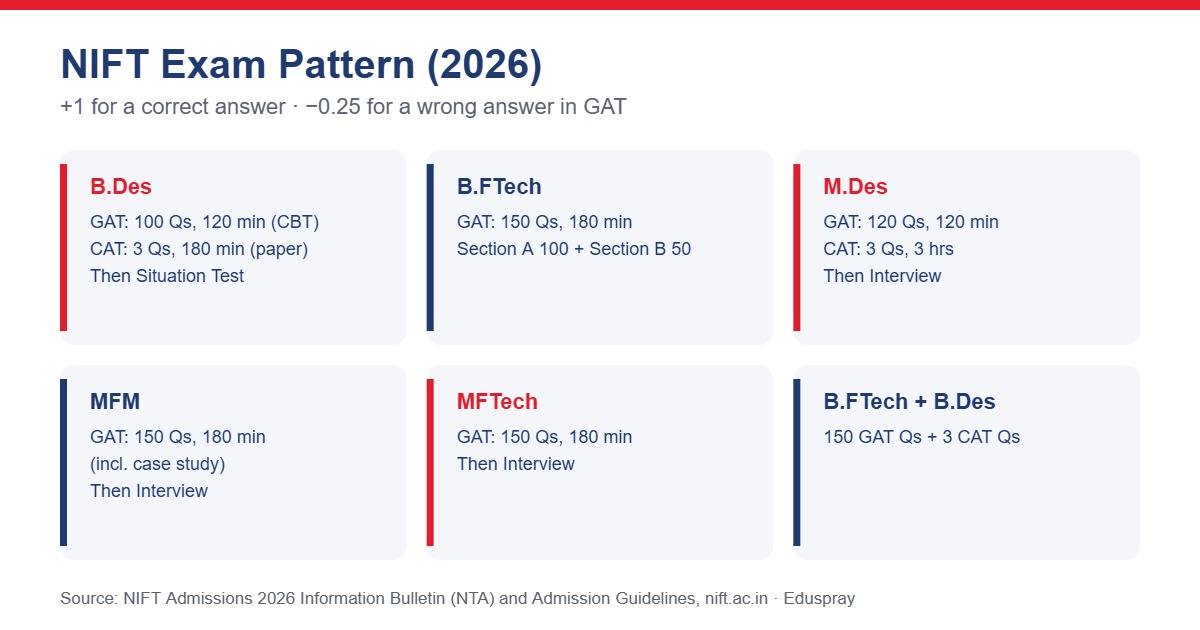
NIFT exam pattern by programme

Paper by Programme

Programme

Stage 1 test(s)

Stage 2

B.Des

GAT (CBT): 100 questions, 120 min + CAT (PBT): 3 questions, 180 min

Situation Test

B.FTech

GAT: 150 questions, 180 min (Section A 100 + Section B 50)

—

B.FTech + B.Des

GAT: 150 questions + CAT: 3 questions

Situation Test (for B.Des)

M.Des

GAT: 120 questions, 120 min + CAT: 3 questions, 3 hours

Personal Interview

MFM

GAT: 150 questions, 180 min (including 30 case-study questions in Section B)

Personal Interview

MFTech

GAT: 150 questions, 180 min

Personal Interview

B.Des GAT: Section-wise Questions

Section

Questions

Communication Ability and English Comprehension

40

General Knowledge and Current Affairs

25

Quantitative Ability

20

Analytical and Logical Ability

15

Total

100 (120 minutes)

B.FTech GAT Section B

Section B area

Questions

Quantitative Ability

15

Analytical and Logical Ability

15

Case Study

20

Total

50 (60 minutes)

Section A of the B.FTech GAT is the same as the B.Des GAT (100 questions in 120 minutes), making a total of 150 questions in 180 minutes.

Exam Day Timings (2026)

Programme

Timing

B.Des

GAT 10:00 am – 12:00 noon · CAT 3:00 pm – 6:00 pm

B.FTech, MFM, MFTech

GAT 10:00 am – 1:00 pm

Key Takeaways

  • B.Des: GAT (100 Qs) + CAT (3 Qs), then Situation Test.

  • B.FTech: GAT only — 150 questions in two sections.

  • PG programmes: GAT (plus CAT for M.Des), then interview.

  • GAT marking: +1 correct, −0.25 wrong.

Pro Tip: In GAT, skip questions you cannot narrow down — each wrong answer costs a quarter mark.

Source: NIFT Admissions 2026 Information Bulletin and Admission Guidelines; NTA public notice (08.12.2025)

Frequently Asked Questions

Is NIFT exam online or offline?

In 2026, GAT was computer-based (CBT) and CAT was pen-and-paper (PBT).

Is there negative marking in NIFT?

Yes, in GAT: +1 for a correct answer and −0.25 for a wrong answer.

How many questions are there in NIFT B.Des GAT?

100 questions in 120 minutes across four sections.
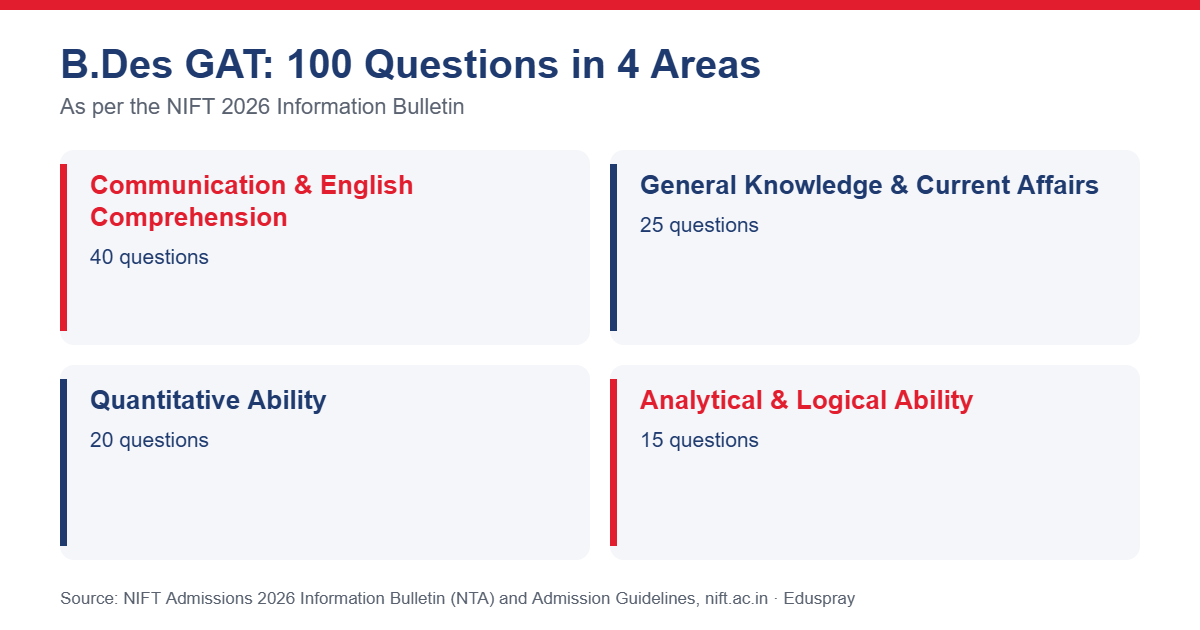
NIFT exam patternNIFT GAT pattern

NIFT Syllabus: GAT and CAT

Full page

NIFT does not publish a chapter-wise syllabus like board exams. Instead, the bulletin describes the areas tested in each paper. Here is what to expect in GAT and CAT.

NIFT B.Des GAT sections and number of questions

General Ability Test (GAT)

Area

What it covers

Communication Ability and English Comprehension

Vocabulary, synonyms and antonyms, idioms and phrases, spelling, sentence correction, reading comprehension and everyday English usage

Quantitative Ability

Arithmetic — percentages, ratio and proportion, profit and loss, simple and compound interest, time and work, speed and distance, averages, basic algebra and geometry

Analytical and Logical Ability

Logical reasoning, inference from information, puzzles, series, coding-decoding, data interpretation and problem solving

General Knowledge and Current Affairs

Current events, general awareness, and awareness of fashion, design, art, culture and business

Case Study (B.FTech, MFM)

Situations from the apparel and fashion industry to test managerial and analytical thinking

Creative Ability Test (CAT)

CAT is taken by B.Des and M.Des candidates. It tests intuitive ability, power of observation, concept development and design ability through drawing and illustration. In 2026, the B.Des CAT had 3 questions in 180 minutes and was a pen-and-paper test.

  • Sketching and illustration — people, objects and scenes

  • Use of colour and composition

  • Creative interpretation of a theme or situation

  • Originality of ideas and clarity of presentation

How Much Each Paper Counts (B.Des)

CAT carries 50% of B.Des final merit, GAT 30% and the Situation Test 20% — so creative ability matters most.

Key Takeaways

  • GAT: English, quantitative, reasoning and general knowledge (plus case study for B.FTech and MFM).

  • CAT: drawing, observation, colour and concept development.

  • CAT carries 50% weight in B.Des final merit.

Pro Tip: For GAT General Knowledge, follow fashion and design news along with general current affairs — questions often touch on brands, designers and textile heritage.

Source: NIFT Admissions 2026 Information Bulletin and Admission Guidelines

Frequently Asked Questions

Does NIFT have an official syllabus?

NIFT describes the areas tested in GAT and CAT rather than a chapter-wise syllabus.

What is asked in NIFT CAT?

Drawing and creative tasks that test observation, concept development, colour sense and design ability.

Is GAT the same for B.Des and B.FTech?

Section A is the same; B.FTech candidates also take Section B with quantitative, reasoning and case-study questions.

NIFT syllabusNIFT CAT syllabus

NIFT Preparation Tips

Full page

Cracking NIFT needs two kinds of preparation at once: aptitude for GAT and creativity for CAT and the Situation Test. With the 2027 exam tentatively on 10 January 2027, here is a practical plan.

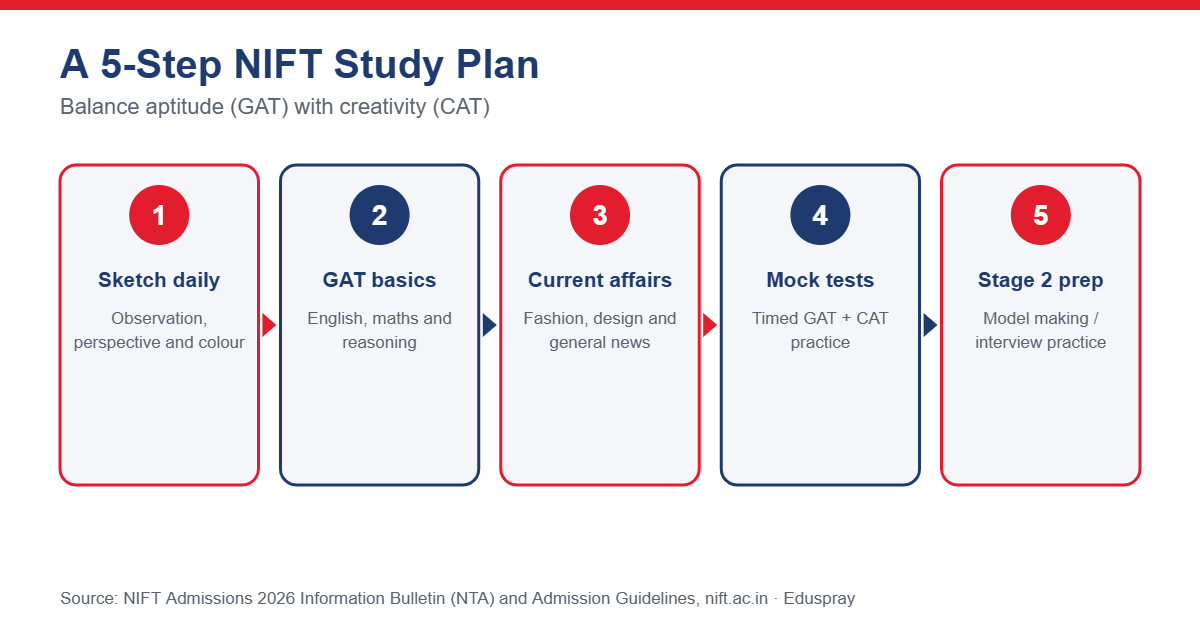
Five-step NIFT study plan

1. Build Your Drawing and Creative Skills (CAT)

  • Sketch every day — people, objects, streets and nature from observation.

  • Practise perspective, proportion, light and shade.

  • Work with colour: colour wheels, harmony and mood.

  • Take a theme (for example “monsoon” or “sustainability”) and turn it into a visual idea in 30–40 minutes.

  • Explain your idea in a few lines — clarity of concept matters.

2. Prepare for GAT

Section

How to prepare

English (40 Qs in B.Des)

Read newspapers daily, build vocabulary, practise comprehension passages

General Knowledge (25 Qs)

Follow current affairs and fashion/design news; revise Indian textiles and crafts

Quantitative (20 Qs)

Revise Class 8–10 arithmetic: percentages, ratios, interest, time-speed-distance

Reasoning (15 Qs)

Solve puzzles, series and logical reasoning sets regularly

3. A 10-Week Plan to January

Weeks

Focus

1–3

Daily sketching + GAT basics in all four sections

4–6

Theme-based CAT practice; GAT sectional tests

7–8

Full mock tests (GAT + CAT) in exam timing

9–10

Revision, current affairs and light practice; rest before the exam

4. Prepare for Stage 2 Early

The B.Des Situation Test checks how you handle materials and build a design idea. PG candidates face an interview on their background and motivation. Start hands-on model-making practice and interview preparation right after Stage 1.

Key Takeaways

  • CAT carries 50% of B.Des merit — practise drawing daily.

  • GAT has negative marking; accuracy beats guessing.

  • Start Stage 2 preparation right after the written exam.

Pro Tip: Keep a sketchbook journal. Revisiting your own work shows how you have improved and gives you ideas to reuse under exam pressure.

Need Help with NIFT Admissions?

Not sure which programme or campus suits you, or how to prepare for CAT and the Situation Test? Eduspray’s counsellors can help you plan your design career and NIFT preparation. Reach out to the Eduspray team for personalised guidance.

Frequently Asked Questions

How should I prepare for NIFT CAT?

Sketch daily, practise colour and composition, and turn themes into clear visual ideas within a time limit.

Is coaching necessary for NIFT?

Not necessarily. Regular sketching, GAT practice and timed mock tests can be done on your own; coaching can help with structured feedback.

How many months are needed to prepare for NIFT?

It depends on your drawing base, but a focused plan of a few months with daily practice works for many students.

NIFT preparationNIFT CAT preparation