Courses Offered Through MHT CET
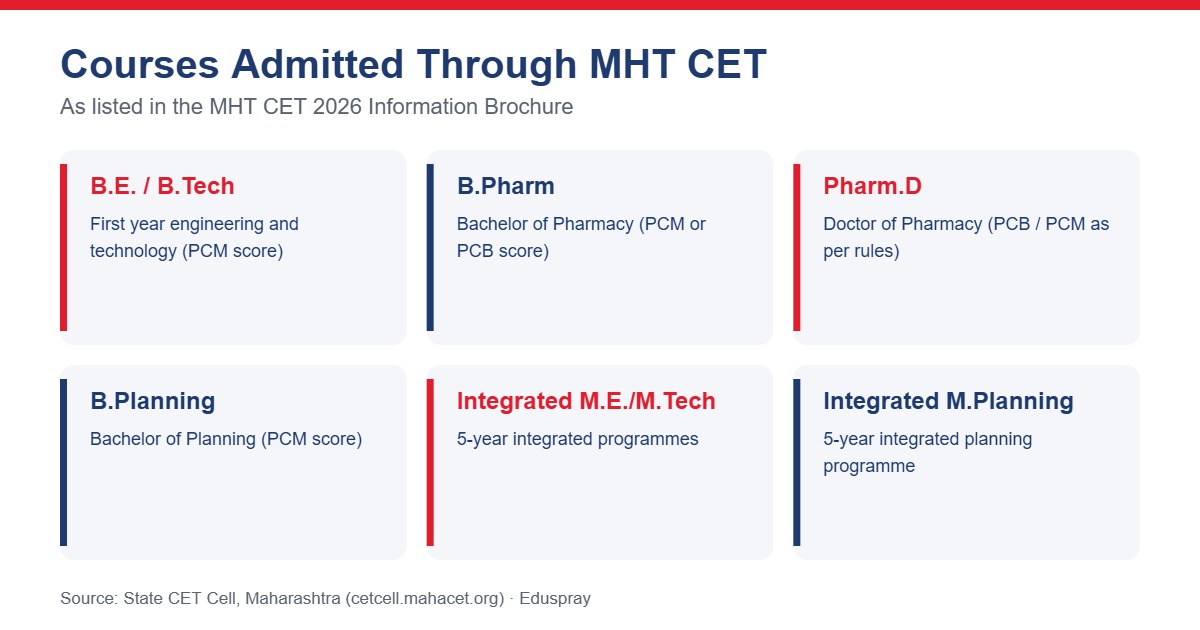
Full pageAn MHT CET score opens doors to a wide range of professional programmes in Maharashtra. As per the official MHT CET 2026 brochure, the test is used for admission to the following first-year courses (agriculture courses are covered in a separate brochure).
Courses Admitted Through MHT CET
|
Course |
Duration |
Group score used |
Admission portal |
|---|---|---|---|
|
B.E. / B.Tech (Engineering and Technology) |
4 years |
PCM (PCB for nine notified branches) |
First Year Engineering CAP (fe portal) |
|
B.Pharm (Bachelor of Pharmacy) |
4 years |
PCM or PCB |
Pharmacy CAP (ph portal) |
|
Pharm.D (Doctor of Pharmacy) |
6 years (including internship) |
PCM or PCB, as per rules |
Pharmacy CAP (ph portal) |
|
B.Planning (Bachelor of Planning) |
4 years |
PCM |
As notified by the CET Cell |
|
Integrated M.E. / M.Tech |
5 years |
PCM |
As notified by the CET Cell |
|
Integrated M.Planning |
5 years |
PCM |
As notified by the CET Cell |
Popular Engineering Branches in Maharashtra CAP
The CAP seat matrix lists dozens of branches. The most sought-after include:
-
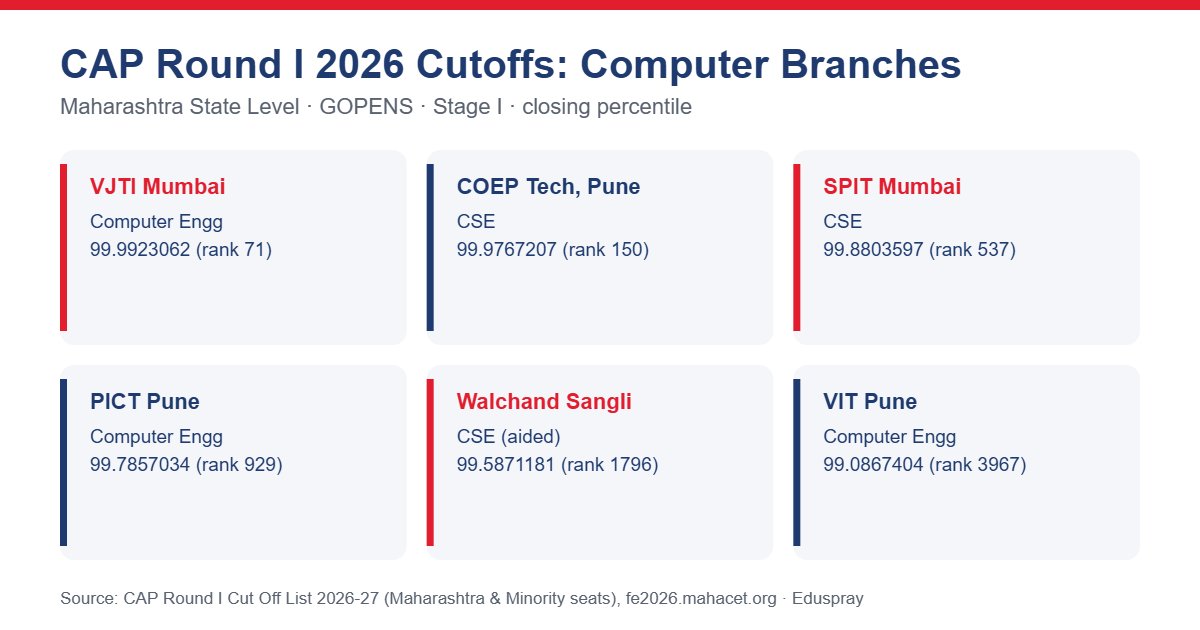
Computer Engineering / Computer Science and Engineering — highest demand; closes above 99 percentile at top institutes
-
Artificial Intelligence and Data Science, AI & ML, Information Technology — newer, high-demand computing branches
-
Electronics and Telecommunication, Electronics and Computer Engineering
-
Mechanical, Civil, Electrical and Instrumentation Engineering — core branches with strong PSU and industry relevance
-
Chemical Engineering and chemical technologies — offered at specialised institutes such as ICT Mumbai
-
Biotechnology, Food Technology, Textile, Printing and Packaging — niche branches, some open to PCB candidates
Types of Institutes in CAP
|
Type |
Examples |
Seat distribution (CAP 2026-27, Schedule I) |
|---|---|---|
|
Government / aided autonomous |
VJTI Mumbai, Walchand Sangli, GCOE Amravati |
100% State Level (no All India seats) |
|
Government / aided non-autonomous |
University departments and non-autonomous government colleges |
70% Home University · 30% Other Than Home University |
|
Special cases |
COEP Tech University · ICT Mumbai |
COEP: 80% State Level, 20% All India · ICT: 70% State Level, 30% All India |
|
Unaided private (non-minority) |
PICT Pune, VIT Pune |
65% State Level (autonomous) or 45.5% HU + 19.5% OHU; 15% All India; 20% institutional (incl. up to 5% NRI) |
|
Unaided minority |
DJ Sanghvi College of Engineering, Mumbai (Gujarati linguistic minority) |
At least 51% minority quota; 15% All India; 20% institutional |
Key Takeaways
MHT CET is used for B.E./B.Tech, B.Pharm, Pharm.D, B.Planning and integrated M.E./M.Tech and M.Planning.
Engineering and pharmacy CAP run on separate portals.
Seat distribution differs for government, aided, private, minority and special institutes.
Pro Tip: Before choice filling, open the official seat matrix for each college you like and check how many seats are available in your category and quota — not just the overall intake.
Source: MHT CET 2026 Information Brochure; CAP 2026-27 Information Brochure (Schedule I); CAP Round I cut-off list 2026-27 — State CET Cell, Maharashtra