
Eduspray
HomeExamsMHT CET 2027Counselling and Admission Process
MHT CET 2027
Entrance Exam

MHT CET 2027

State Common Entrance Test Cell, Maharashtra

MHT CET is the Maharashtra state entrance test for B.E./B.Tech, B.Pharm, Pharm.D and B.Planning admissions through CAP. Check 2027 status, eligibility, PCM/PCB pattern, syllabus, fees, percentile normalisation, cutoffs and counselling.

MHT CETMHT CET 2027Maharashtra CETMHT CET PCMMHT CET PCBCAP MaharashtraState CET Cell

Last updated: 16 Oct 2026

HomeExamsMHT CET 2027Counselling and Admission Process

Counselling and Admission Process

Updated 16 Oct 20263 topics

MHT CET CAP Counselling Process

Full page
MHT CET CAP Counselling Process

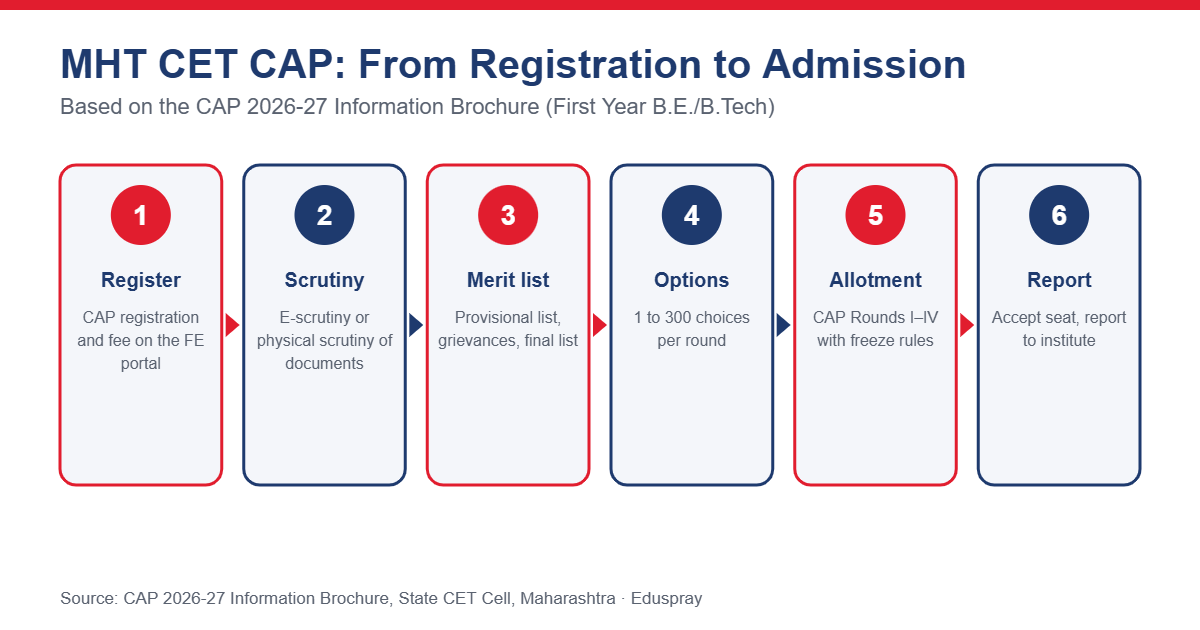
After the results, admission to first-year B.E./B.Tech in Maharashtra happens through the Centralised Admission Process (CAP) run by the State CET Cell on the FE portal (fe2026.mahacet.org for 2026-27). Pharmacy has a separate CAP portal. The process below follows the official CAP 2026-27 Information Brochure.

MHT CET CAP counselling steps from registration to reporting

Step 1: CAP Registration and Document Upload

Register on the CAP portal, fill in personal, academic and category details, upload scanned documents (JPG/GIF, at least 150 dpi, up to 1 MB each) and pay the CAP registration fee. In 2026, candidates chose between E-Scrutiny (online verification) and Physical Scrutiny (at a facilitation centre).

Step 2: Document Verification and Confirmation

Your documents are verified by scrutiny centres. Once verified, your application is confirmed. If there are errors, you are asked to correct or re-upload.

Step 3: Provisional and Final Merit Lists

The CET Cell publishes a provisional merit list, allows a grievance window to correct errors, and then publishes the final merit list along with the seat matrix for CAP Round I.

Step 4: Option Form (Choice Filling)

  • Filling and confirming an online option form is mandatory for each round you want to participate in.

  • You can fill a minimum of 1 and a maximum of 300 options (college + branch combinations) in order of preference.

  • Once confirmed, options for that round cannot be changed.

Step 5: Seat Allotment Rules (Freeze / Betterment)

Situation

What happens (CAP 2026-27 rules)

Round I: allotted your 1st preference

Seat is auto-frozen; you must accept it and you are out of later rounds

Round I: allotted a lower preference — you choose “Freeze”

Allotment becomes final; no further rounds

Round I: lower preference — accept but “Not Freeze”

You keep the seat and can participate in later rounds for betterment

Round I: lower preference — not accepted

You can still participate in later rounds

Round II

Seat from your first 3 preferences is auto-frozen

Round III

Seat from your first 6 preferences is auto-frozen

Rounds II–IV: better option allotted

Earlier seat is cancelled automatically

After Round IV

No further betterment; the allotment is final

Step 6: Seat Acceptance and Reporting

Accept the allotted seat by paying the seat acceptance fee (online or as instructed) and completing self-scrutiny or reporting to the Admission Reporting Centre within the given time. Then report to the allotted institute with original documents and fees. The institute verifies documents, uploads the admission online and issues a system-generated receipt. Not reporting in time means the seat is forfeited.

CAP 2026-27 Timeline (Reference)

Event

2026 date

CAP registration

2 July – 19 July 2026 (after extensions)

Provisional merit list

22 July 2026

Final merit list and Round I seat matrix

27–28 July 2026

Round I option form

28–30 July 2026

Round I allotment

2 August 2026

Round II / III / IV allotments

13 August / 24 August / 3 September 2026

Last date for all admissions

15 September 2026

Timeline dates are from news reports of the official CET Cell schedule. Check FE portal notices for the 2027-28 schedule.

Cancellation and Refund

Admission can be cancelled online. If cancelled before the full-refund deadline, all fees are refunded except ₹1,000 and original documents are returned within 2 days. After that deadline, only the security deposit and caution money are refundable.

Key Takeaways

  • CAP is run by the State CET Cell on the FE portal; pharmacy has its own portal.

  • You can fill up to 300 choices per round — the option form must be filled every round.

  • A first-preference allotment in Round I is auto-frozen.

  • Report to the institute on time, or you lose the seat.

Pro Tip: Put your genuine first choice at No. 1 — if allotted in Round I, it is auto-frozen. Fill your options thoughtfully: a long, well-ordered list protects you from ending up without a seat.

Need Help with MHT CET and CAP?

Confused about choice filling, cutoffs or which college fits your percentile? Eduspray’s counsellors help you shortlist colleges, plan your CAP option form and avoid costly mistakes. Reach out to the Eduspray team for personalised guidance.

Source: CAP 2026-27 Information Brochure (UG/PG, dated 02.07.2026), State CET Cell; CAP schedule from news reports (secondary)
Frequently Asked Questions

How many choices can I fill in the MHT CET CAP option form?

Between 1 and 300 choices per round, as per the CAP 2026-27 brochure.

What happens if I get my first preference in CAP Round I?

The seat is auto-frozen. You must accept it and you will not take part in later rounds.

How many CAP rounds are there?

Up to four CAP rounds; the Round IV allotment is final.

Seat Reservation and Quotas

Full page
Seat Reservation and Quotas

Seats in Maharashtra’s CAP are divided by quota (Home University, Other Than Home University, State Level, All India, minority, institutional) and then reserved by category, gender and special groups. Knowing which seats you are eligible for helps you read cutoffs correctly and plan choices.

Reservation percentages for Maharashtra CAP seats

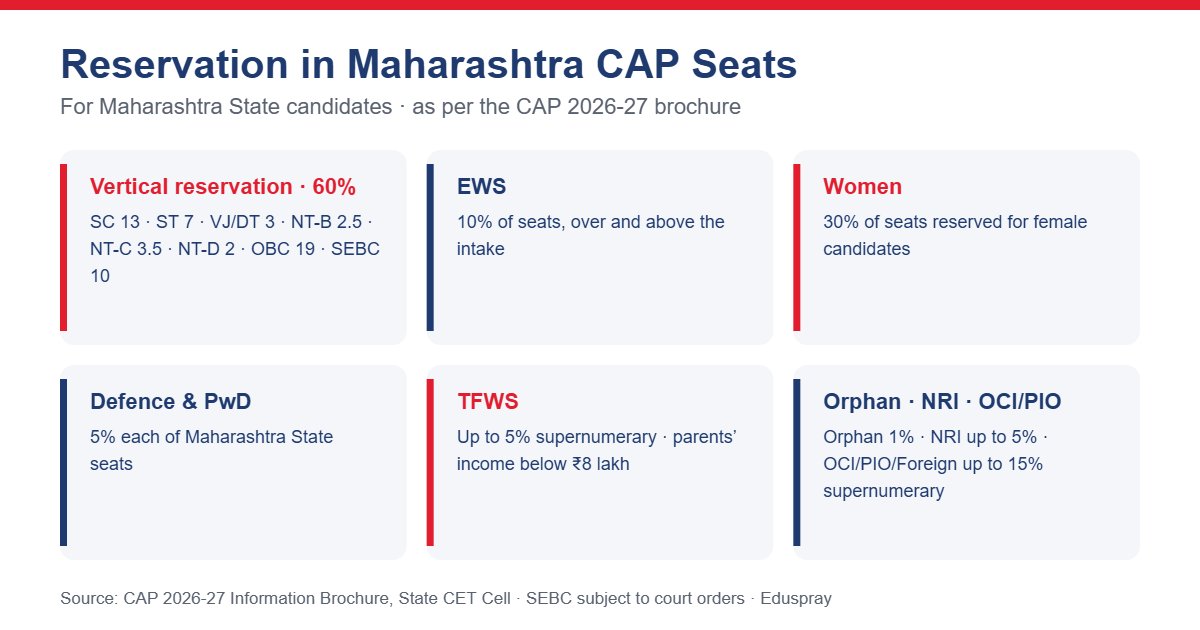
Category-wise Reservation for Maharashtra State Candidates

Category

Reservation

Scheduled Castes (SC)

13%

Scheduled Tribes (ST)

7%

Vimukta Jati / Denotified Tribes (VJ/DT – NT-A)

3%

Nomadic Tribes B (NT-B)

2.5%

Nomadic Tribes C (NT-C)

3.5%

Nomadic Tribes D (NT-D)

2%

Other Backward Classes (OBC)

19%

Socially and Educationally Backward Class (SEBC)

10% (subject to court orders)

Total

60%

Reservation for backward classes applies only to Maharashtra State candidates. Candidates of VJ/DT, NT, OBC, SBC and SEBC categories must submit a valid non-creamy layer certificate, and reserved-category candidates need a caste validity certificate.

Other Reservations and Special Seats

Quota

Share (CAP 2026-27)

Who is eligible

Economically Weaker Sections (EWS)

10%

Maharashtra candidates not covered by other reservations, with a valid EWS certificate

Women

30%

Female candidates

Defence

5% of Maharashtra State seats

Wards of defence personnel and ex-servicemen, as defined

Persons with Disability (PwD)

5% of Maharashtra State seats

At least 40% permanent disability certified by a competent authority

Orphan

1% of CAP seats

Orphan candidates with the prescribed certificate

Tuition Fee Waiver Scheme (TFWS)

Up to 5% (supernumerary)

Maharashtra candidates with parents’ annual income below ₹8 lakh — tuition fee is waived

NRI

Up to 5% (within institutional quota)

Non-Resident Indian candidates

OCI / PIO / Foreign nationals / Children of Indian workers in Gulf

Up to 15% (supernumerary)

As defined in the brochure; exempt from MHT CET

Quota-wise Seat Distribution (Schedule I, CAP 2026-27)

Institute type

How seats are split

Government / aided – autonomous

100% State Level

Government / aided – non-autonomous

70% Home University, 30% Other Than Home University

COEP Technological University

80% State Level, 20% All India

ICT Mumbai and LIT Nagpur

70% State Level, 30% All India

Dr. Babasaheb Ambedkar Technological University, Lonere

85% State Level, 15% for candidates from Konkan districts

Unaided private (non-minority)

65% State Level (autonomous) or 45.5% HU + 19.5% OHU; 15% All India; 20% institutional (including up to 5% NRI)

Unaided minority

At least 51% of CAP seats for minority candidates; 15% All India; 20% institutional; rest for Maharashtra candidates

Government / aided minority

50% minority quota; remaining 50% State Level (autonomous) or 35% HU + 15% OHU

TFWS: A Scheme Worth Knowing

Under the Tuition Fee Waiver Scheme, eligible Maharashtra candidates from families earning below ₹8 lakh a year get the tuition fee waived on supernumerary seats of up to 5%. TFWS seats are allotted on merit and appear as separate entries in the official cutoff lists. Keep a valid income certificate from a Maharashtra authority ready.

Key Takeaways

  • 60% of Maharashtra CAP seats are reserved for SC, ST, VJ/DT, NT, OBC and SEBC categories.

  • EWS gets 10%, women 30%, defence and PwD 5% each, orphans 1%.

  • TFWS gives a tuition fee waiver to eligible students with family income below ₹8 lakh.

  • Seat split by Home University, State Level and All India depends on the type of institute.

Pro Tip: Apply for your caste validity and non-creamy layer certificates well before CAP. Missing or expired certificates are one of the most common reasons a category claim fails at verification.

Source: CAP 2026-27 Information Brochure (Rules 7 and 8, Schedule I), State CET Cell, Maharashtra

Frequently Asked Questions

What is the total reservation in Maharashtra CAP?

60% for SC, ST, VJ/DT, NT-B, NT-C, NT-D, OBC and SEBC categories, plus EWS (10%) and other special reservations.

What is TFWS in MHT CET admissions?

The Tuition Fee Waiver Scheme offers up to 5% supernumerary seats with tuition fee waived for Maharashtra candidates whose parents earn below ₹8 lakh a year.

Is there reservation for girls?

Yes. 30% of seats are reserved for female candidates.

Documents Required for CAP Admission

Full page

Document verification is where many CAP applications run into trouble. The official CAP 2026-27 Information Brochure (Section 17) lists the documents every candidate must upload, plus additional documents depending on the candidature type and category claimed. Scans must be in JPG or GIF format, at least 150 dpi, and up to 1 MB each.

Documents Required for All Candidates

  • SSC (Class 10) marksheet

  • HSC (Class 12) / Diploma / B.Sc. marksheet

  • Marksheet of the qualifying examination

  • MHT CET score card (or JEE Main score card for All India seats)

  • School Leaving Certificate (where needed to support a claim)

  • Indian nationality certificate (or an equivalent document accepted in the brochure)

Additional Documents by Candidature Type

Candidature

Additional document(s)

Type A

Domicile certificate, or birth certificate / school leaving certificate showing birth in Maharashtra

Type B

Domicile certificate of the candidate or of the father / mother

Type C (parent in Central Government service posted in Maharashtra)

Proforma A

Type D (parent in Maharashtra Government service)

Proforma B, or undertaking of place of settlement for a retired employee

Type E (Maharashtra–Karnataka border area)

Proformas G1 and G2

Additional Documents by Category / Special Claim

Claim

Additional document(s)

SC / ST

Caste or tribe certificate and caste validity certificate

VJ/DT-NT, OBC, SBC, SEBC

Caste certificate, caste validity certificate and non-creamy layer certificate valid up to 31 March 2027

EWS

EWS certificate in Proforma V, valid for 2026-27

Orphan

Proforma U

Defence

Proforma C or D, parent’s domicile and transfer / joining papers

Persons with Disability

Disability certificate and candidate’s domicile certificate

J&K / Ladakh migrant

Proformas J, K, L and M, as applicable

TFWS

Income certificate showing parents’ income below ₹8 lakh, issued by a Maharashtra authority

Minority

Proforma O declaration (or leaving certificate showing religion / mother tongue), plus domicile or Type A documents

NRI / OCI / PIO / Foreign national / Gulf worker’s ward

Documents as notified by the Competent Authority

Validity dates above are for the 2026-27 admission year; expect the 2027-28 brochure to move them forward by a year.

Document Checklist Tips

  • Keep the originals and a few sets of self-attested photocopies ready for reporting at the institute.

  • Make sure your name is spelt the same way on all documents. If it is not, keep supporting proof (such as a gazette notification) ready.

  • Check the validity date of NCL and EWS certificates — expired certificates are a common reason for rejection.

  • Apply for caste validity early; if it is pending, follow the exact instructions in the current brochure.

Key Takeaways

  • Every candidate uploads SSC and HSC marksheets, the CET score card and a nationality proof.

  • Type A candidates need a domicile or a birth / leaving certificate showing birth in Maharashtra.

  • Reserved categories need caste and caste validity certificates; most also need NCL.

  • Scans: JPG/GIF, at least 150 dpi, up to 1 MB each.

Pro Tip: Create a single folder named “CAP documents” with clear scans named by type (for example SSC_marksheet.jpg). It makes upload, e-scrutiny corrections and institute reporting much faster.

Source: CAP 2026-27 Information Brochure (Section 17 and Proformas), State CET Cell, Maharashtra

Frequently Asked Questions

Which documents are needed for MHT CET CAP?

SSC and HSC marksheets, MHT CET score card, nationality proof, and documents for your candidature type and category, as listed in the CAP brochure.

Is caste validity required for CAP?

Yes. Reserved-category candidates need a caste certificate and caste validity certificate; most also need a valid non-creamy layer certificate.

What format should scanned documents be in?

JPG or GIF, at least 150 dpi, up to 1 MB each (CAP 2026-27).