

Exam Pattern and Syllabus
MHT CET Preparation Tips
MHT CET rewards accuracy, speed and strong State Board fundamentals. Because there is no negative marking and results are percentile-based, a smart plan can lift you thousands of ranks. Here is a practical, month-by-month strategy built around the official pattern.
1. Make the State Board Textbook Your Base
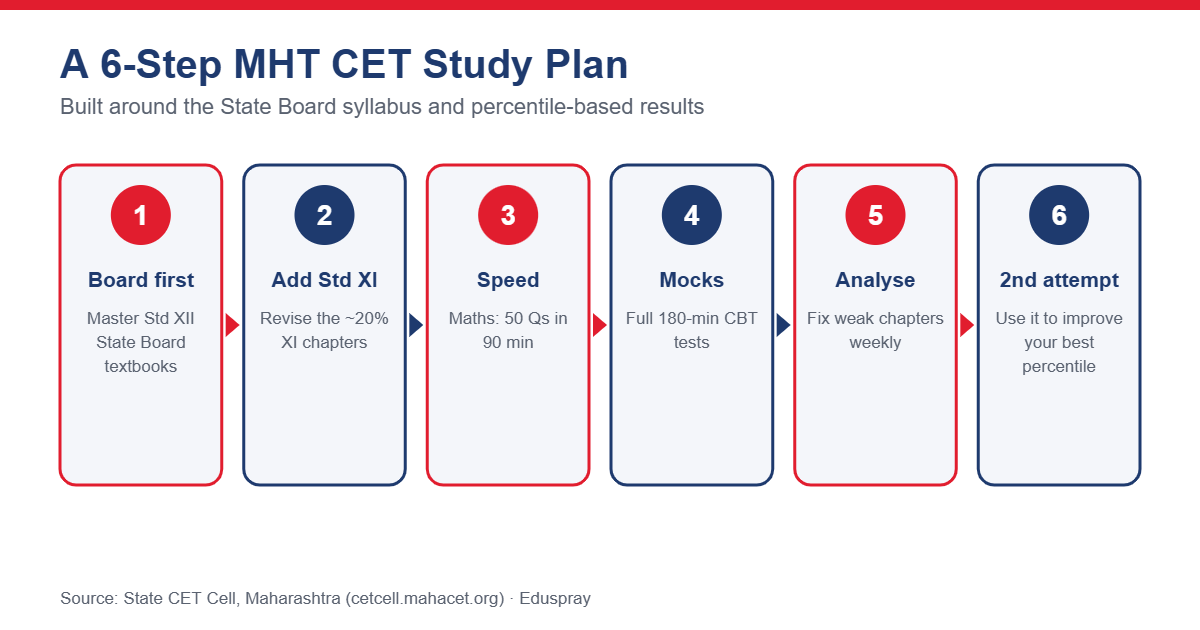
About 80% of questions come from the Std XII State Board syllabus. Read every chapter of the Balbharati textbooks line by line — especially examples, solved problems and tables. Many MHT CET questions test concepts exactly as they are explained in these books.
2. Do Not Skip the Std XI Chapters
Only a fixed list of Std XI chapters is tested (about 10 questions per subject, 20 in Biology). Revise these chapters early — they are high-scoring because the list is short and predictable.
3. Subject-wise Strategy
|
Subject |
Focus areas |
Strategy |
|---|---|---|
|
Physics |
Rotational Dynamics, Current Electricity, Electrostatics, Wave Optics, Semiconductor Devices |
Learn formulas with units and dimensions; practise numericals daily |
|
Chemistry |
Organic chapters (Halogen Derivatives to Amines), Electrochemistry, Chemical Kinetics, Coordination Compounds |
Physical: numericals; Inorganic: tables and trends; Organic: name reactions and conversions |
|
Mathematics |
Calculus (differentiation, integration, differential equations), Vectors, Line and Plane, Matrices, Probability Distributions |
Build speed — 50 questions in 90 minutes; learn shortcuts and standard results |
|
Biology |
Genetics and Molecular Basis of Inheritance, Reproduction, Human Health and Diseases, Biotechnology, Ecology |
NCERT-style reading plus State Board diagrams; revise facts and terminology repeatedly |
4. A Sample 6-Month Plan
|
Phase |
What to do |
|---|---|
|
Months 1–3 |
Complete the Std XII syllabus alongside board preparation; revise Std XI listed chapters on weekends |
|
Month 4 |
Topic-wise MCQ practice; one sectional test per subject per week |
|
Month 5 (board exams) |
Board exams take priority; keep 30–45 minutes daily for MCQ revision |
|
Month 6 (after boards) |
Full-length 180-minute CBT mocks every 2 days; analyse every mock |
|
Between attempts |
Fix weak chapters revealed in your first attempt; take 4–6 more mocks |
5. Exam-Day Strategy
-
Two-pass method: Answer all easy questions first, mark the tough ones for review, then return.
-
Never leave blanks: With no negative marking, an educated guess can only help.
-
Watch the clock in Paper I: Physics and Chemistry share one 90-minute timer and are auto-submitted.
-
Read options carefully: MHT CET options often differ by a sign, a unit or a single word.
6. Use the Two-Attempt Advantage Wisely
If the two-attempt system continues in 2027, treat the first attempt as a serious exam, not a trial. The better total percentile counts, so a strong first attempt gives you a safety net and lets you take the second with less pressure.
Recommended Study Resources
-
Maharashtra State Board (Balbharati) Std XI and XII textbooks — the primary source
-
Official sample/mock tests on the CET Cell portal, when available
-
NCERT textbooks for extra Biology and Chemistry practice (for concept clarity)
-
Topic-wise MCQ books aligned with the current State Board syllabus
Key Takeaways
Build on the State Board textbooks — they cover about 80% of the paper.
Maths is worth 100 marks in PCM; speed in Maths is the biggest differentiator.
Take full-length 180-minute CBT mocks after board exams.
There is no negative marking — attempt every question.
Pro Tip: Maintain an “error notebook”. After each mock, write down every question you got wrong and why. Revising this notebook in the last week is worth more than solving new papers.
Need Help with MHT CET and CAP?
Confused about choice filling, cutoffs or which college fits your percentile? Eduspray’s counsellors help you shortlist colleges, plan your CAP option form and avoid costly mistakes. Reach out to the Eduspray team for personalised guidance.